More than Enough
I always wanted to be an architect. My childhood was spent in rambling medieval houses in the shadows of two great cathedrals—Lincoln until the age of twelve and then Canterbury. They were buildings that had not been planned—spiral staircases, corridors and blocked doors, grandeur and the patched-up in juxtaposition. And all in sight and sound of cathedrals: the way back from school was through the cloisters and bells rang a curfew at nine every night. I once gave a lecture on the oddness of this upbringing and called it ‘On Being Very Cold’, a nod to waking up to frosty bedrooms. But the coldness of living in houses with no central heating was in part an austerity, a pared-back quality of being sheltered in places where there were other, slower and deeper concerns. These places had a longer life. These were houses with stone steps that had become gently scalloped, bannisters burnished by thousands of iterative movements, windows where the leaded glass rippled. And there were the marks of how these buildings had been created: these were places ‘known and handled’ to borrow the words of the poet and artist David Jones. And as a child I found windowsills and the turns of staircases to curl up on and read, those liminal spaces where you hide, turned inwards into words, turned outwards as you watch light change.
In becoming a potter I’m still trying to find those particular places where the world knits itself together, the places where you actually want to be. And then my practice is to put something down—a group of vessels on a shelf, some porcelain in a vitrine—and see how that minute quantum of energy changes, articulates and catches shadows, reflects. And pauses the huge velocity of the world, the tear-it-up, move-it-on speed.
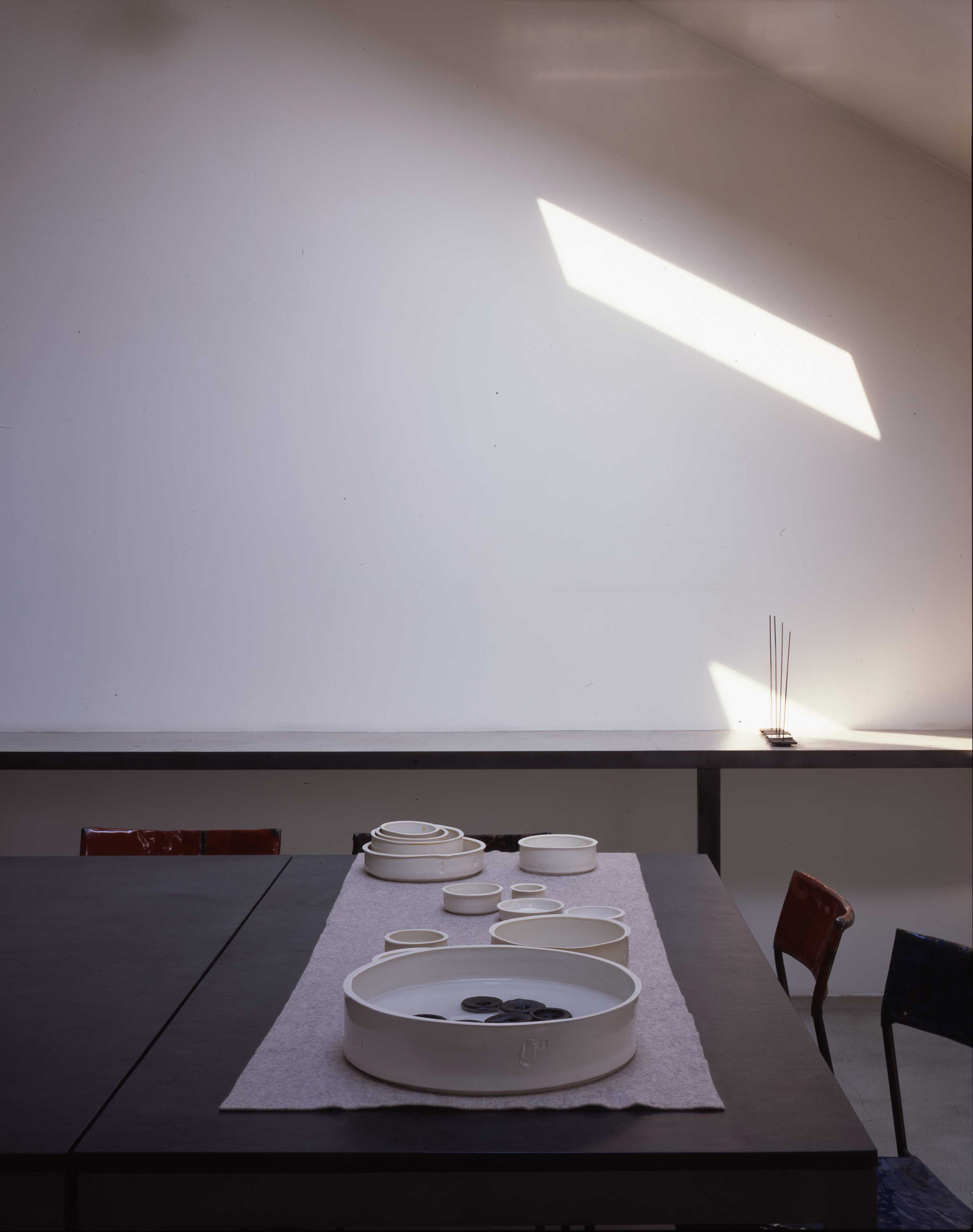
This lambent book is a meditation on time. It is a series of pauses in particular buildings. William has chosen houses and artists’ studios, an art-gallery in the country, the private spaces of architects and potters and families. What threads them together is his personal philosophy that quietness is not really about good taste at all, more a rather astringent exercise in balancing objects and sight lines, an attempt to find correspondences between the made and the found. His feeling for the kindness of materials shines through. You want to touch.
This reminds me of the Cistercian writer and hermit Thomas Merton’s photographs of the woods and barns around his hermitage: a way of bringing a focus onto the quotidian. After visiting Pleasant Hill, the Shaker community in Kentucky, in 1961 and 1962, he wrote of ‘marvellous, silent, vast spaces around the old buildings. Cold, pure light… How the blank side of a frame house can be so completely beautiful I cannot imagine. A completely miraculous achievement of forms.’ [1] He found that the Shakers’ attentiveness to how to live fully in the material world was reflected in the care they took with the disposition of objects, the positioning of a window, the construction of a chair: ‘The peculiar grace of a Shaker chair is due to the fact that it was made by someone capable of believing that an angel might come and sit on it.’
So here we have a beautiful book of places. Some I have known all my life, some I have been lucky enough to make work for. Many are new to me. But what this carefully paced book does is to walk me into different spaces, let me sit and inhabit one possibility of becoming quieter and then another. It is in praise of shadows. That is enough, I want to say. That is more than enough.