that pause of space
Or ever the silver cord be loosed, or the golden bowl be broken, or the pitcher be broken at the fountain, or the wheel broken at the cistern. Then shall the dust return to the earth as it was: and the spirit shall return unto God who gave it. Vanity of vanities, saith the preacher; all is vanity.
—Ecclesiastes 12:6–8
An Autobiography, but not a record of fact.
—Basil Bunting, “Briggflatts,” 1966
i
I unexpectedly left school in the winter of 1981. It was complicated. I had just turned seventeen, so everything was complicated except the simple things in my life: I was going to be a Poet and a Potter and be apprenticed and go to Japan. I couldn’t stay at home. I went to New York and stayed with family friends in Gramercy Park and walked and walked, and bought books at the Strand and read them on park benches, and went to poetry readings at the Y (queuing for Joseph Brodsky in the rain, Anthony Hecht reading “The Venetian Vespers”), and haunted the Chinese ceramics galleries at the Met (those celadons, the sky-after-rain and kingfisher blues, the mutton-fat grays). And late one January afternoon, near closing time, weary, baffled by Boucher, I met Chardin for the first time. It was the Frick and it was love: that rectitude, that sensuality. “We stop in front of a Chardin as if by instinct like a traveler weary of the road choosing, almost without realising, a place that offers a grassy seat, silence, water and cool shade,” said Diderot. Chardin’s Still Life with Plums with its handful of plums dusted with autumnal bloom, that glass two thirds full of water in front of the dark carafe, the two squash, the terracotta shelf of a pantry, and that scumbled wall. It was life barely arranged, more like life discovered. And yet the formal pleasures, one object in front of another, the different gleams and glints on fruit and glass, contained a sense of “things known and handled,” to borrow the words of David Jones. They had what he termed haecceity, the thusness of the world: they were themselves not idealised versions of themselves. This was how objects felt. Or, to be more precise, how I wanted the world to feel, how to make the world singular in the way that a poem by, say, Marianne Moore, allowed an inhabitation of a moment of encounter. Norman Bryson got it right:
…it was rumoured that he applied the pigment with his fingers. Which may well be true: paint in Chardin is trowelled and stroked, it mimics the texture of terra-cotta or of glaze; it dribbles; its texture is buttery, or like cream cheese, it is an almost comestible substance which everywhere announces that it has been worked. Inside the painting, one sees objects which are constantly being touched: polished metal, familiar plates and cups, linen freshly pressed and tables swept and cleaned.
It is an epiphany, of course.
I’d been making pots since childhood, spent hours every afternoon in the workshop of an elderly potter. I knew how to prepare clay, knead it in spirals so that the air was expelled, cut it into pieces with the twisted wire made from rabbit snares, weigh each ball and sit at my kick wheel and throw one onto the spinning surface and wet my hands and centre it. Bring the world into focus. And then to create board after board of vessels that were almost the same: some approximation of the litany of domestic ware, pots for use. It was an attempt at starting out. I hadn’t lived. They didn’t.
That is what epiphanies are: moments when the place you are stays exactly the same but everything is transformed. To be seventeen and away from home and see that the world can be as simple as this glass of water and know that it is what you want more than anything else. To be able to pick something up and drink and put it down again.
ii
It is steel. The strike breaking, the pulse of violence, the money, the shifting of allegiances, the law, the litany of mills, coking plants, logistics, profit and loss, confrontations, litigation, the iron ore and railroads all return to smoke and dust. It is Pittsburgh. And all this starting out—this founding industry, the labour of myths, beginnings, narratives of where you start, what you give back, how far you have come—returns to dust. This made me shades into I made this. And because it is steel, it is about one material being made of several: iron and coke and flame transforming the rawness of the world. And then this one singular material becoming everything else in the world: railroads and ships and factories, the girders for buildings, cities.
So when you buy Goya’s Forge painting, what are you buying? Three men, one about to bring his hammer down onto the red hot metal held with tongs by two others in the forge. It is a nexus of limbs, arms straining, feet placed to give stability. The clothes are torn and rent. It is pure heat and sound, density. The forge is an ellipse of scarlet. Bodies and fire: this is transformation not through the gods but through labour. Forget Ovid’s Metamorphoses. This is the work of work.
And work is not redemption. I think of the apotheosis of labour in the vast mural of Carnegie in Pittsburgh. There is no ascent: it is a bringing down.
I stand here and hear the hammer blow and then the next, the regularity a pulse as direct as the counting in a work by Steve Reich. And because I count the world too, count vessels, hear words and phrases and see their rhythms I begin to feel that this is the sound of this exhibition. The auditory imagination, wrote Eliot, is where the “feeling for syllable and rhythm, penetrating far below the conscious levels of thought and feeling, invigorating every word; sinking to the most primitive and forgotten, returning to the origin and bringing something back.”
So repetitions traverse these installations. There are pieces of milled steel, some as heavy as girders, others cut and polished to a sixteenth of an inch in thickness. Some pieces are patinated, some are aged and stained, some rusted, and some waxed. There are pieces of steel formed into angles and then powder-coated in implacable white. Some are leaning against porcelain vessels, some stacked nearby. Edges are cut surgically or left raw.
Steel is here to support, to topple, to balance, to arrange, to disarrange, to derange, to gather and to isolate, to shelter, to map, to count and to recount. Also to ground.
I use steel as grounds for porcelain. I think of all that ormolu—the chased bronzes that hold porcelain jars away from the riverine marbled surfaces and delicate veneered storytelling of the French furniture at the Frick—and want more contact.
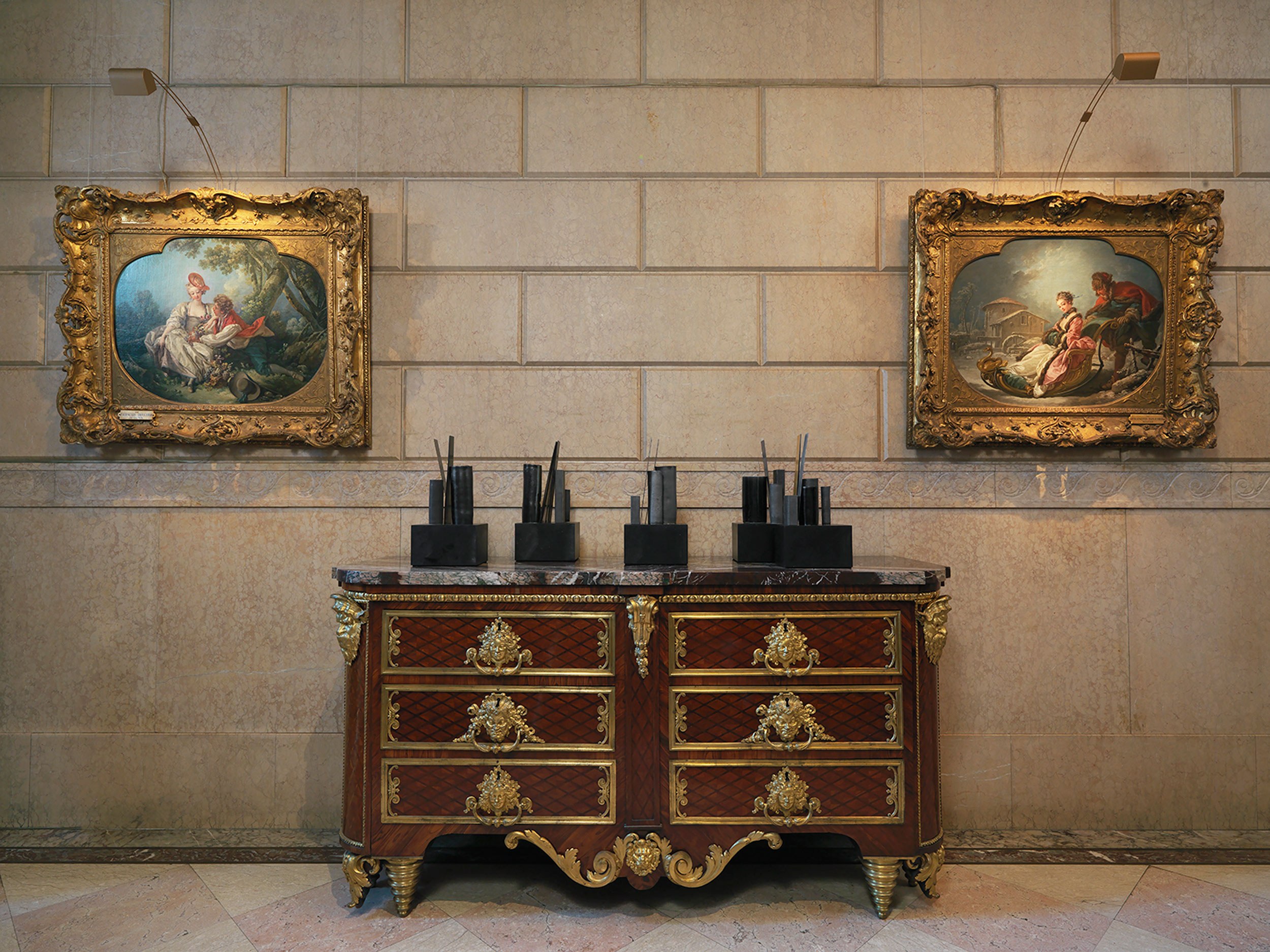
So for the Boulle commode, among Boucher’s The Four Seasons in the West Vestibule, I make steel light. Five black steel grounds, each ground with a few black-glazed porcelain vessels, each vessel supporting a few very thin steel shards. Some are gilded. Leaning one object against another makes me think of leaning against a wall like a Daumier tramp or an itinerant in some damp Dutch painting. You feel the wall, the tree, the flank of the horse. This contact is not forever: it is a moment.
This installation of porcelain and steel catches the light from the window. I’m bringing something back.
iii
It is said, disparagingly, that Frick bought Cuyp’s Cows and Herdsman by a River because it suggested the Youghiogheny River as it meandered past the Overholt Distillery in Broad Ford. And Hobbema’s Village Among Trees because it recalled his childhood. And that his penchant for portraits of women in hats—Lawrence’s Julia, Lady Peel—was because his wife and daughter liked hats. Which apart from the toxic snobbery (who is he to have these masterpieces?) lets the idea of resemblance slip away into the shallows of comedic anecdote. It is far more intriguing. Proust weaves recognition into encounters with people and memories of places. The sight of Odette makes Swann remember a figure in a Botticelli, Albertine a portrait by Luini, Bloch is “an astonishing likeness … the same arched eyebrows and hooked nose and prominent cheekbones” of Bellini’s portrait of Mehmet II. This interweaving of a remembered image and an encountered person brings a space of aspiration, a possibility of being not like someone else but someone else.
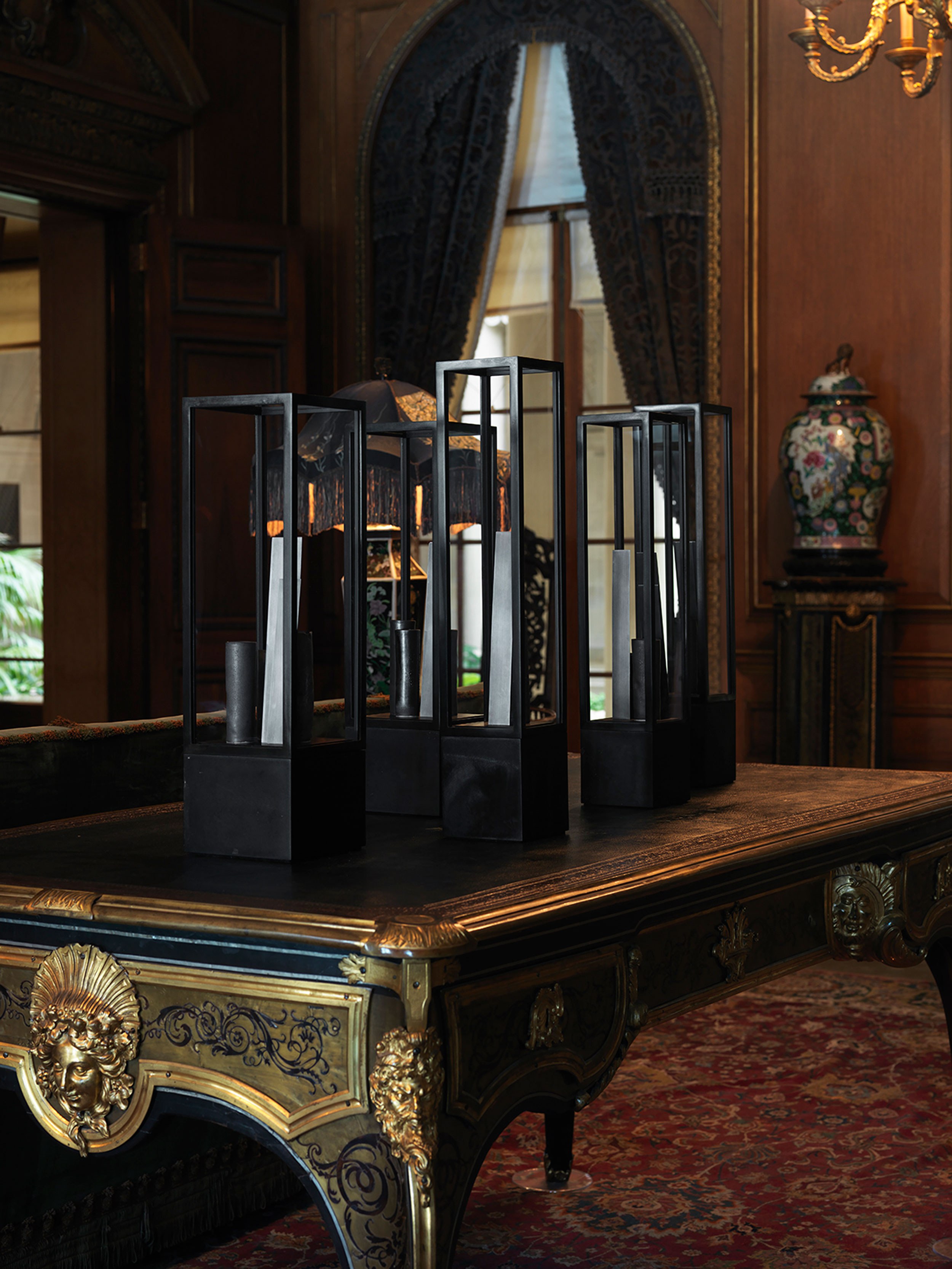
I think of the portraits that Frick chose for the Living Hall. El Greco’s St. Jerome, attenuated fingers lightly placed on a passage of his great Latin translation of the Bible. Bellini’s St. Francis in the Desert with his missal on his desk, Holbein’s Thomas Cromwell and Sir Thomas More with those firms hands holding a document, a command, a sentence. And Titian’s portrait of the writer Pietro Aretino. These are men of power who become his peers. The Living Hall becomes an idea of a study, centred on the great black and gold desk by Boulle from 1710, a bureau plat that speaks of authority. Boulle invented this form, simplifying it so that there are fewer drawers and four rather than eight legs: this desk is a place where you sit and write. It is a room without books where the word rules.
So I make an installation for a study. It is called sub silentio. It shares the language of steel light, with five steel grounds and tall porcelain vessels and leaning steels, but here they are held within vitrines. This enclosure is a holding back: the withheld, the not yet said. The paper in the hand, the thought not written, the closed missal, the finger on the text.
At the Frick, you can become, sequentially, French, then English, and then possibly Dutch, before ending in a reverie of Siena in the Enamels Room. You move as Frick moved, through rooms and passages that are stage sets, places of theatrical intent, of aspiration and possibility.
To be in the Boucher Room or the Fragonard Room means hoping to be French. Which means, of course, desire. The staging, theatre, pause, and revelation of desire. Not only in The Pursuit, The Meeting, The Lover Crowned, Love Letters, Reverie and Love Triumphant but in the unfolding mechanical table by Carlin, the way in which you pull a shelf forward and release a catch and fold up and over so that this table becomes a dressing table with a tilted mirror with compartments for items for your toilette, with another space for paper and a quill and inkpots. So that your day starts by looking at yourself, writing to your lover, beautiful and witty. This is the seduction of the perfectly modulated. Look again at the small gesture between a Sèvres garniture of porcelain potpourri vases, peasants attractively disporting themselves under the trees as the clouds change. There is nothing to do and so much time in which not to do it.
It is hard to think of surfaces and veneers and inlays without the admonishments of Ruskin on authenticity, the horror of one material inserted into another. It is duplicity. It is material intrigue, a whispering and plotting offstage rather than robust honest talk of carpenter and wood, potter and clay.
But here, gloriously, like a fugue of Charpentier are the glories of the French furniture: “various woods” oak and ash and walnut of course but then the unspooling list of bloodwood and amaranth, and holly, tulipwood, satinwood, maple, pearwood, kingwood. And when you get to Boulle, the veneering with brass, turtle shell, and ebony. This is plenitude. And with it comes a certain lassitude, the feeling of more and then possibly more. There are gratuitous tendrils around objects. Fragonard’s lovers barely make it out of the undergrowth.
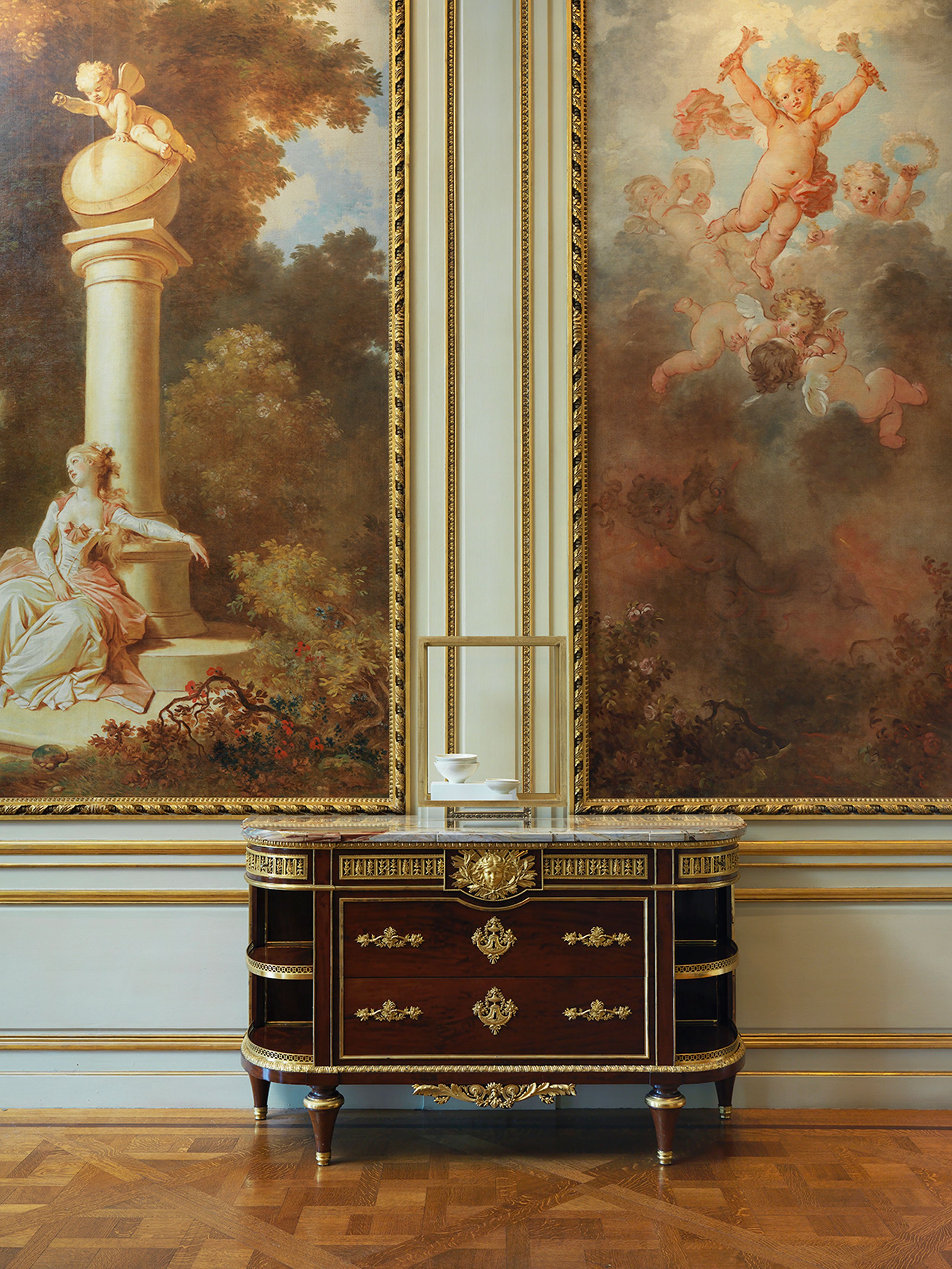
So for the Fragonard Room, underneath Reverie, I place a gilded vitrine on a commode created by Riesner with four curved shelves made to hold porcelain and the mask of Apollo, hair aflame with two branches of bay framing his face. It is a gilded steel vitrine holding a white steel box on which I’ve stacked celadon vessels. A bowl holds shards of gold from a broken bowl.
Remembering Rilke’s poem on being someone other, I read “The Archaic Torso of Apollo”: “We cannot know his legendary head / with eyes like ripening fruit. And yet his torso / is still suffused with brilliance from inside, / like a lamp, in which his gaze, now turned to low // gleams in all its power.” The poem ends: “for there is no place / that does not see you. You must change your life.”
So there is no place that does not see you.
iv
Frick is learning to be English in the Dining Room. This is appropriate. Dining takes time. In this context, it means Gainsborough and Reynolds. It means buying furniture from the Dukes of Devonshire at Chatsworth. Even French furniture became English by ducal association. It means that whole dream of dining rooms with soft reflections and married daughters framed on the wall, a deer park beyond. It means having a beyond. The dream of the safety of ancestry, those long corridors of begat, begat, begat.
It also means a certain scale. Not continental excess—unnecessary towers, battlements, wings—but a sort of moderated plutocratic steadiness. Frick used Sir Charles Allom, who had made the interiors of Buckingham Palace look safe. The grandeur of this room lulls.
This room makes me want to break things. Not a few delicate shards but serious breakage. Fragments end abruptly. Their edges are their significance. They speak of wholeness and disjuncture at the same moment, hold their histories as a pause. Shards are romantic, indicating grandeur. You are drawn to the break, the scar on the side of the head where there was an ear, the ankle ending in planes where a foot should be. The break is the moment when storytelling begins.
I reflect on families. I’ve traveled though my Jewish family history from Odessa to Paris and Vienna. I nod to the severity of my dour maternal Presbyterian ancestors in Aberdeen, to my Dutch merchant family trading coffee in Amsterdam. But when I think of my Englishness, I need the sound of breaking porcelain.
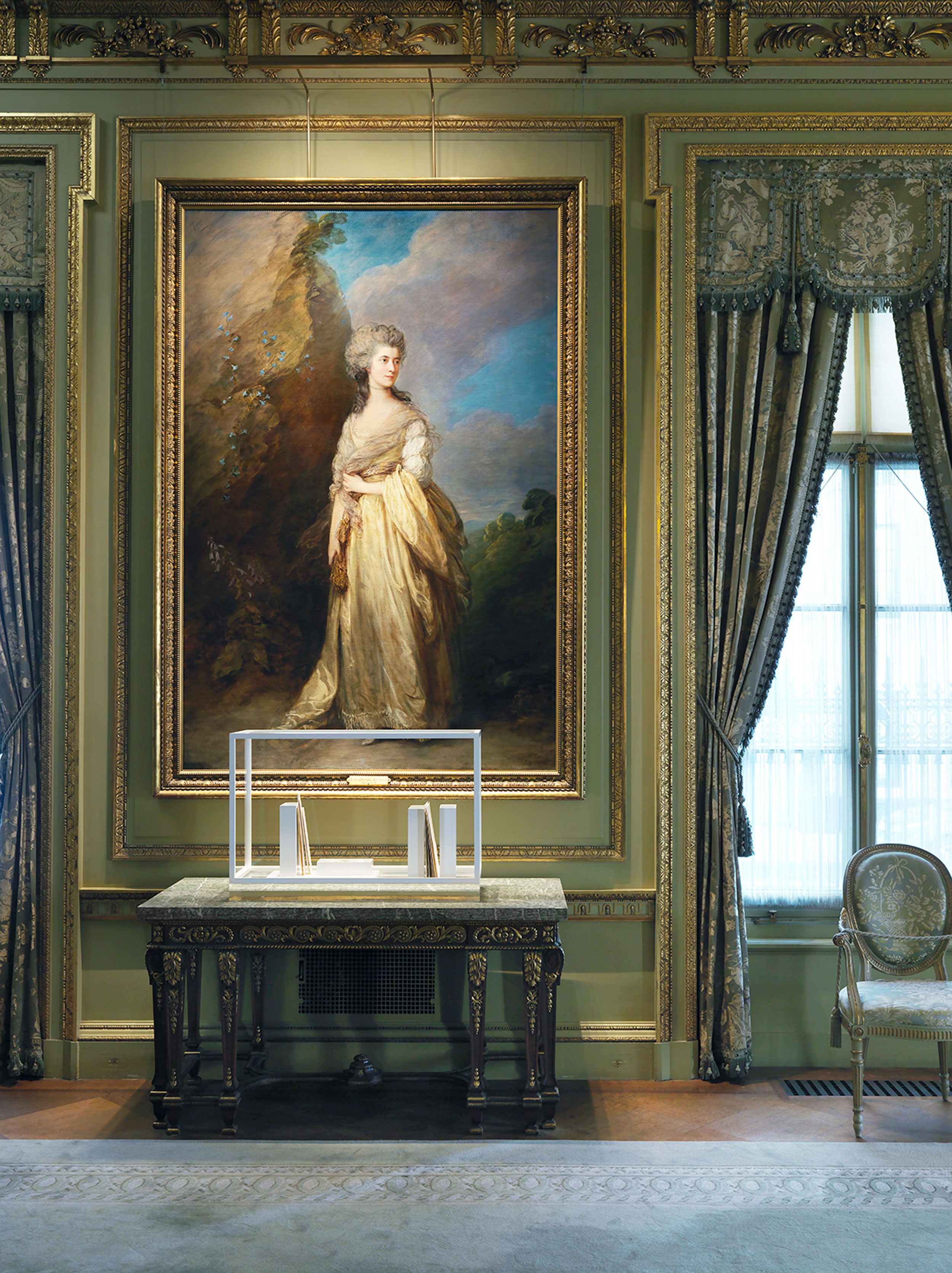
These installations float below the Gainsborough portraits. Each vitrine holds heavy steel boxes. Ethereally thin sheets of porcelain lean against them. A single steel box holds shattered porcelain: on living in an old country.
v
Thinking about beginnings, I think of Dresden. In 1717, the administrator of the experimental porcelain manufactory in Dresden, Herr Johann Melchior Steinbruck, wrote, “The inventor Mr. Bottger… had a part of the red wares coated with black glaze, producing a wholly new style of porcelain, the likes of which no one in Asia has ever seen. Furthermore, he had some of these pieces engraved, so that one sees the red body against the black, and some were also lacquered with gold and colours, and in this way a very beautiful appearance was achieved.”
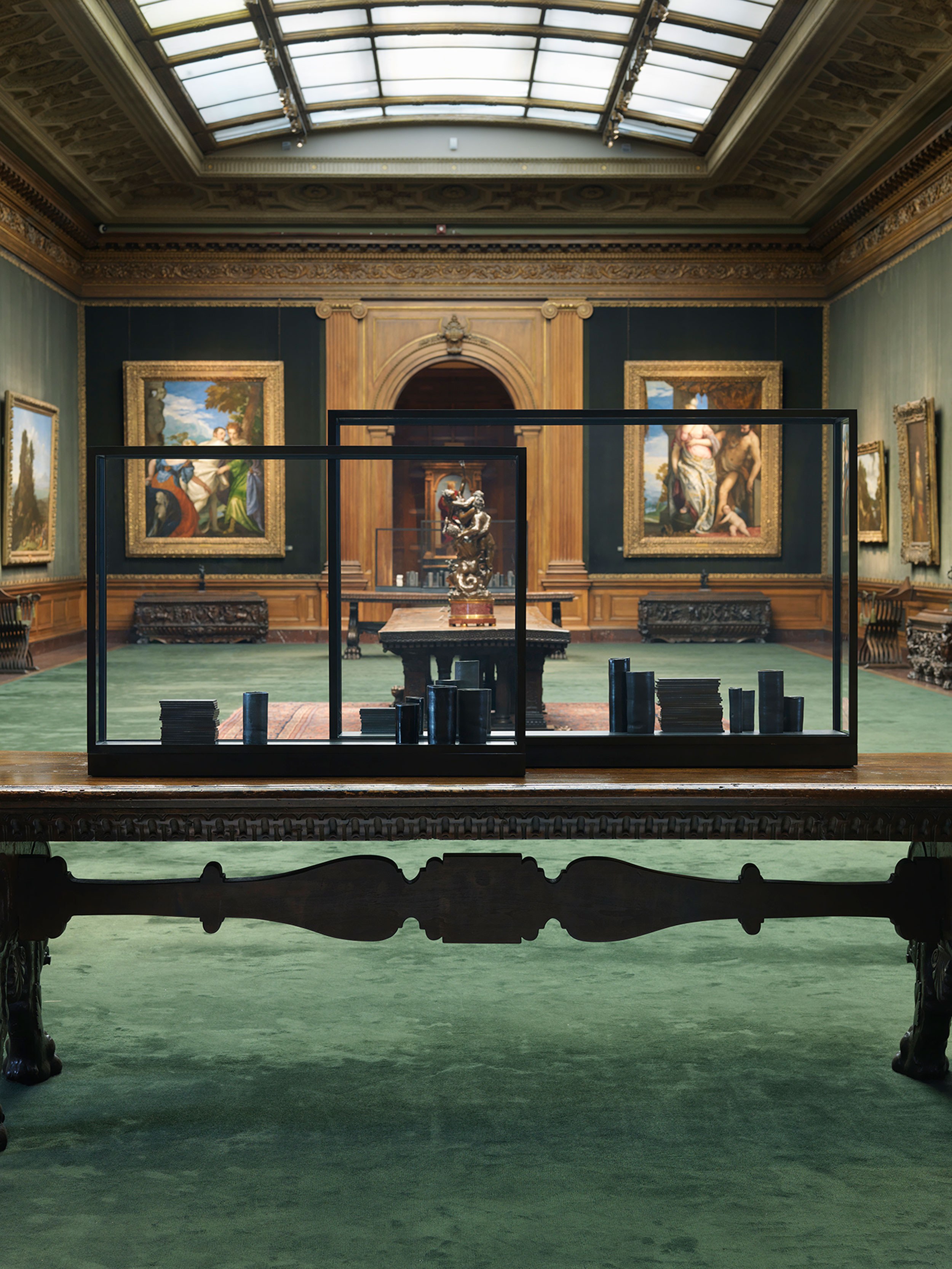
Black porcelain comes before white porcelain. It is compelling as it seems to lie somewhere among stone and lacquer and porcelain: new materials with which you could achieve new possibilities. I started to make black porcelain a decade ago, searching to understand how shadows worked among dark vessels, wanting to test darkness. My experiments took me to lacquer of course, that peculiar softness of black that seems to radiate from worn lacquer. Junichiro Tanizaki writes In Praise of Shadows that “only in dim half-light is the true beauty of Japanese lacquerware revealed. The rooms at the Waranjiya are about nine feet square, the size of a comfortable little tearoom, and the alcove pillars and ceilings glow with a faint smoky lustre, dark even in the light of the lamp. But in the still dimmer light of the candle stand, as I gazed at the trays and bowls standing in the shadows cast by the flickering point of flame, I discovered in the gloss of this lacquerware a depth and richness like that of a still, dark pond, a beauty I had not seen before.”
Still, dark ponds are seductive. I think of those restorers and dealers smoking their paintings, over varnishing them to give them a patrician depth. Of the cultic collecting of famille noir Chinese porcelain at the end of the nineteenth century—the belief that the black-ground porcelains, with their trailing peony blooms floating on inky night, were imperial works of the Kangxi Dynasty. When they had been created twenty years before and then sold by Bing and Duveen for exorbitant sums in the overheated club of collectors. They sit brooding now in the Library.
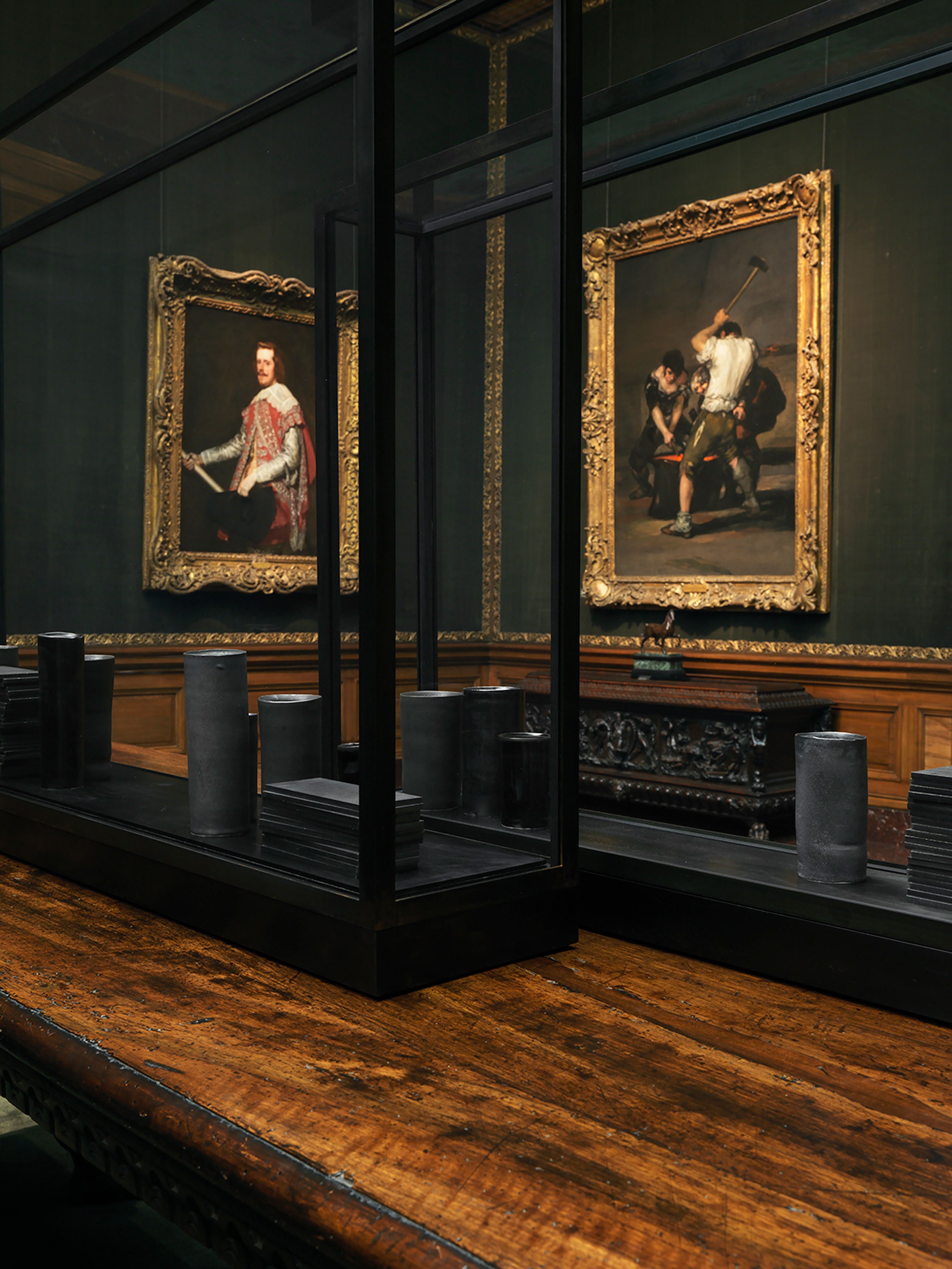
Black porcelain holds a strange place for me. It is black milk, the transfigured whiteness that drives Paul Celan’s great poem of anger and despair “Todesfugue” (Death Fugue): “Black milk of morning we drink you at dusktime / we drink you at noontime and dawntime we drink you at night / we drink and drink.” For the West Gallery, I have made two pairs of huge vitrines to stand on the refectory tables, runs of black vessels and stacks of black steel, the insistent pulse of industry, the cost, the “gang-boss aus Deutschland.”
This is the space to meditate on black. Frans Hals’s Portrait of a Man with the landscape of black cloth, the rivulets and cascades and rivers of shadow across velvet cut distended so that white surf breaks through. Van Dyck’s Synders portraits clothed in seriousness, shrouded in sumptuary Puritanism, an encoded darkness of power.
Nothing is as complicated as Rembrandt’s darkness.
My black vitrines become double portraits. They overlap each other, borrow space from the other. They are noontime and dawntime and from darkness to darkness.
vi
A childhood of churches. Not of sitting in enforced piety through endless sermons but one of exploration. My father was Chancellor of Lincoln Cathedral and then Dean of Canterbury, and we grew up in ramshackle medieval houses with spiral staircases and chapels and attics. I once gave a very short lecture to the Rectory Society titled “On Being Very Cold.” And we were free: running through the roof spaces of the cathedral at Lincoln above the Gothic vaults, across the thin wooden bridges in the towers, daring each other to look down. Those great volumes of the clerestories, danger and happiness. Hours in the cathedral library. Borrowing my father’s key to the crypt when we moved to Canterbury and the exhilarated knowledge of that empty building at night, the rise and fall of those cascades of stairs from crypt to choir.
It wasn’t dark. The floodlights that bathed the golden Normandy stone every night meant that the tracery of the windows, the stained glass, washed through the spaces. You could lie in the middle of the nave and look up at the canopy of Gothic tracery.
Later I found Pieter Saenredam’s paintings of Dutch church interiors, where the cadences of the columns of a nave or the ribs of the vaulting are painted in every gradation of white, spaces where the formal, abstracted qualities of light and shadow can be played out. There is pleasure: a boy with a hoop, a dog marking its territory, graffiti on the wall. Here, say these passionate, lucid pictures, everything is allowed.
Passionate lucidity: you create a structure, a rhythm of intervals and then let go. Hence altarpieces.
One of my very first installations, made for an exhibition in Kettle’s Yard in Cambridge, was called Predella, after the thin strip that runs underneath the main body of the altarpiece that can be a sort of jostling together of all the life that couldn’t be fitted in, a commentary. And that led to making cabinets with opening doors: a sort of modest devotional work that moved around the idea that some works are more powerful by having their presence known but not displayed.
I became obsessed by the way in which the architecture of the throne or the study window or the walls represented in an altarpiece create containment and disclosure. The way in which saints and apostles and martyrs can be elbow to elbow with a donor, the way a landscape is both known—the trees by the road, that curve in the river—and perfected. Or in the way that the Merode Altarpiece from the workshop of Robert Campin, the world of the Annunciation, is that of a carpenter’s workshop: each door and latch and beam and bench and table are sawn and lathed and drilled with exactitude.
This is the way sacred space materialises encounter: it holds different temporalities and allows them to coexist.
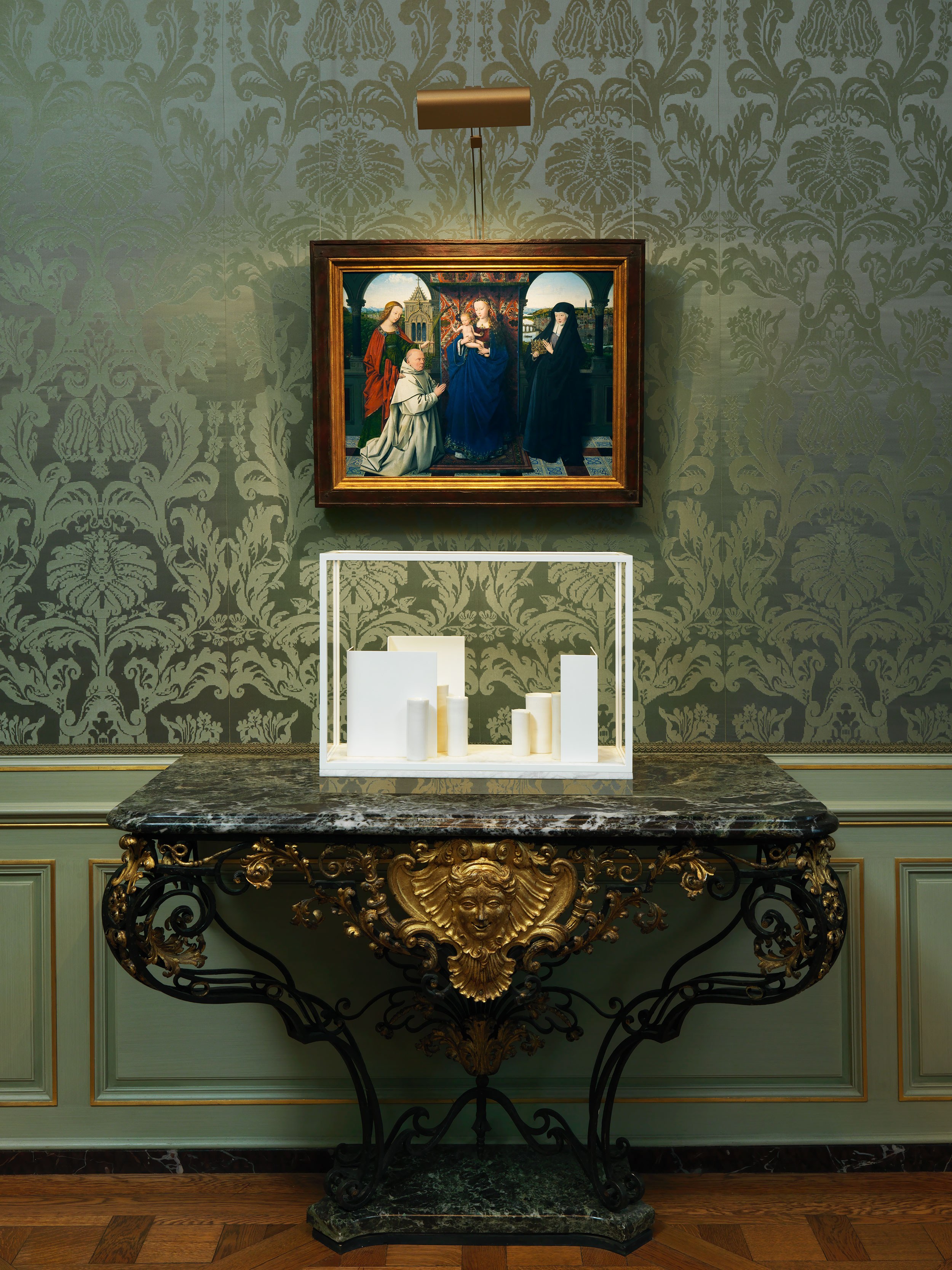
So for the table in the Anteroom, where the Virgin and Child with St. Barbara, St. Elizabeth, and Jan Vos of Jan van Eyck and workshop is hanging, I’ve made an installation to hold light, think it through. Four folded steel panels interlock. Two are gilded so that an aura washes over the white porcelain vessels. I am not sure how this works, how light can congregate, but I do know that there is something about the fugitive beauty of the change of light and shadow around gold that makes me think of how memory works. The halo navigates the space between the silence of things and the silence of people.
Hence an annunciation: an encounter of few words.
vii
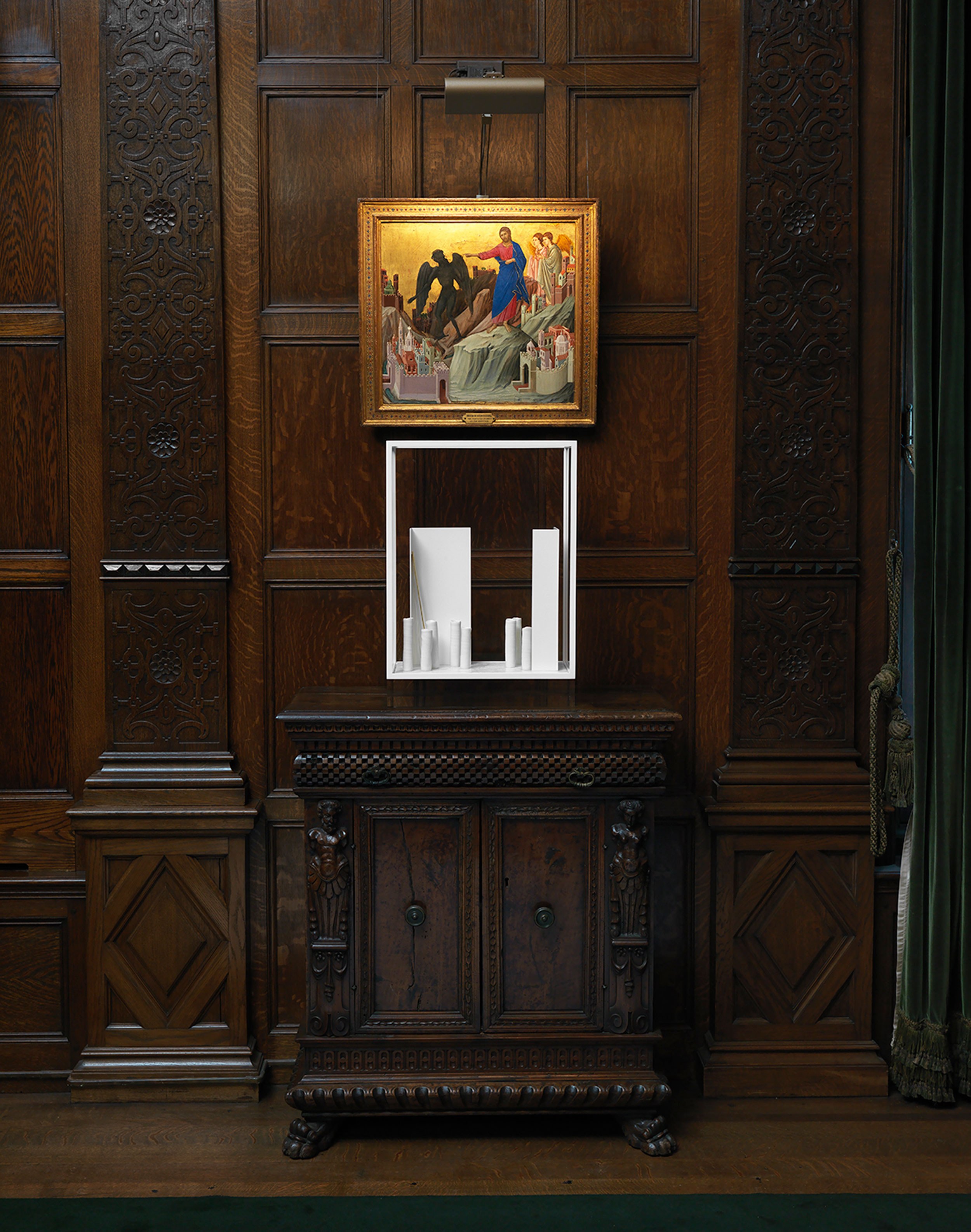
The world is laid before Christ: perfectly crenelated walled cities of towers and churches and palaces—their gates open—are there for him to command. And he is commanding the Devil, convincingly, malignly hairy, to leave.
Duccio’s Temptation of Christ on the Mountain—once part of his great Siena altarpiece, the Maestà —holds me.
Walled cities are another kind of vessel too.
So I make a piece for the beautiful tough credenza below the Duccio. It is a walled city, and I name it the temptation of Christ on the mountain.
viii
So there is gold. Gold threads its way through this whole exhibition. And gold means thinking about light, about halos and about aura, the way in which light moves, about shadows again. I decide that clarity can delude, that sometimes there can be more lucidity in the shadows. They have what Keats called, in a marginal note in Paradise Lost, “a sort of Delphic Abstraction a beautiful thing made more beautiful by being reflected and put in a Mist.”
“Delphic Abstraction” means that you work harder for your beauty. For several years, I make vitrines with occluded glass so that the objects held within are out of focus. They look, said an art critic, like a bad eye test. I loved these pieces. When I started the journey into the early history of porcelain that became The White Road, I realised that I was caught up in the history of optics and philosophers and mirrors, reading Spinoza, thinking about the grinding of lenses.
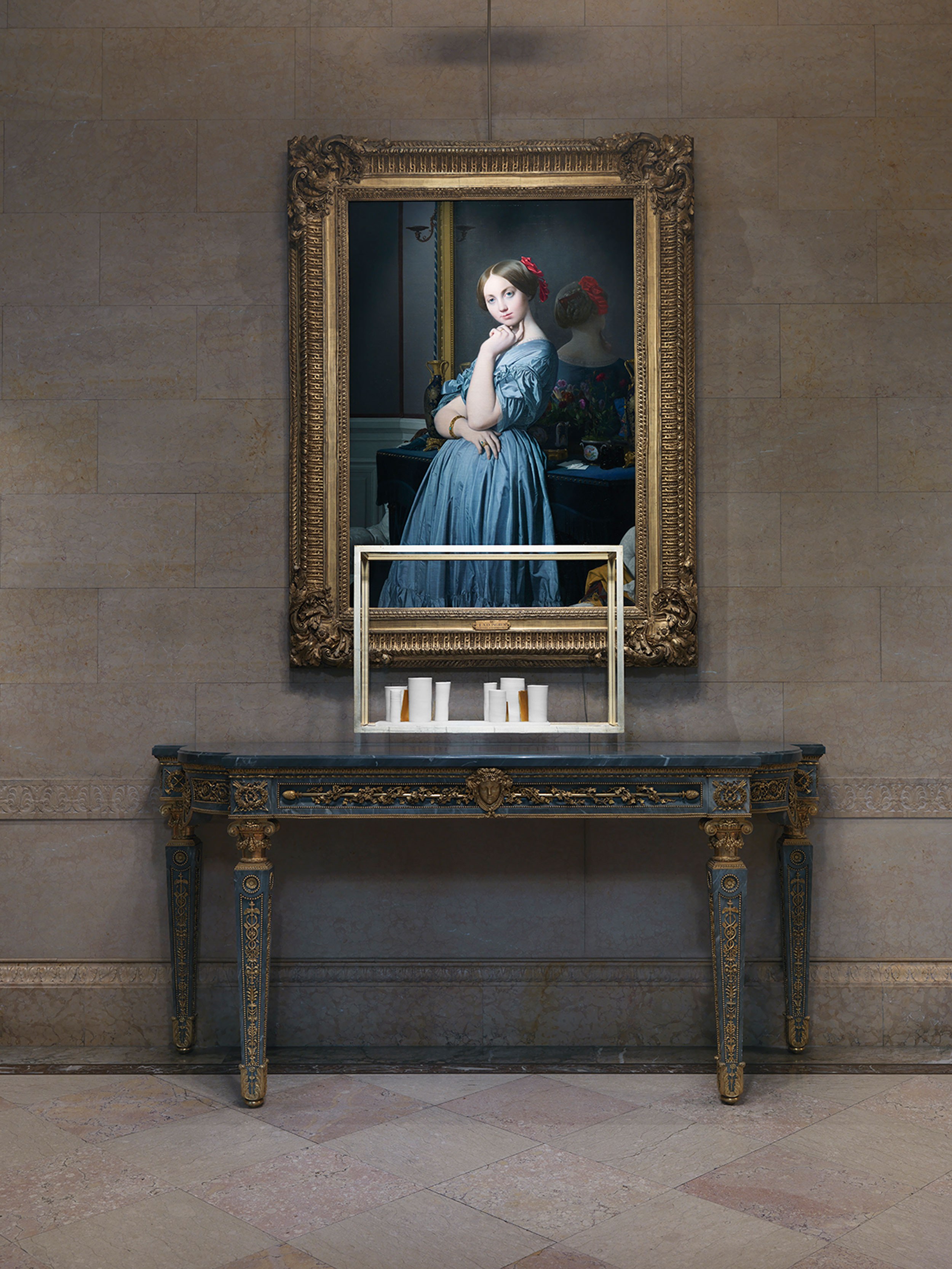
So I start another of my walks through the Frick, looking at mirrors and windows and the places where reflections congregate. And how the whole house can be read as a descant on light and darkness—not only a piece of Belle Epoque interior decoration but as a staging for a complete day, morning light and evening light, the place for fires to be lit, for lamps to glow. The place of top light and the rare raking west light. And I meditate on what Gouthière, the greatest gilder of the eighteenth century, is doing—creating a kind of music with how light falls. “He works with proximity to a fireplace, above the chimney, near a mirror, on a pedestal, the pedestal, a table itself. He makes works for fire and light: firedogs, candelabras, wall sconces, chandeliers, chimneypieces.”
Gouthière’s table stands below Ingres’s Comtesse d’Haussonville in the North Hall. So on a thick plinth of Perspex, I place a thin piece of marble that I gild from below. It pools like “that golden stain of time” that Ruskin wrote of in his Seven Lamps of Architecture as the Lamp of Memory. And on this scant marble, I place a dozen porcelain vessels, unglazed but fired to the highest temperature of my kiln so they acquire an ashen blue-gray hue. And I lean fragments of gilded porcelain among them and finally place a golden vitrine over the ensemble. The hem of the blue dress of the comtesse just comes into the empty space created by the structure of the vitrine, spills in, steals.
This is that pause of space. I steal this title from Emily Dickinson and feel pleased.
ix
In the Library, I think that perhaps Frick didn’t like books. There is a deadly feeling that the runs of volumes might have been supplied rather than chosen, that they sit broodingly in their Morocco bindings unread. I stand in front of this English Edwardian desk and realise that this is an English problem. And that the ten stacked columns in the central well are Bancroft’s Book of Wealth: An Inquiry into the Nature and Distribution of the World’s Resources and Riches, and a History of the Origin and Influence of Property, Its Possession, Accumulation and Disposition in All Ages and among All Nations or, according to an advertisement in the New York Times in 1898, “all that is worth knowing concerning wealth from the dawn of history to Joe Leiter’s wheat.”
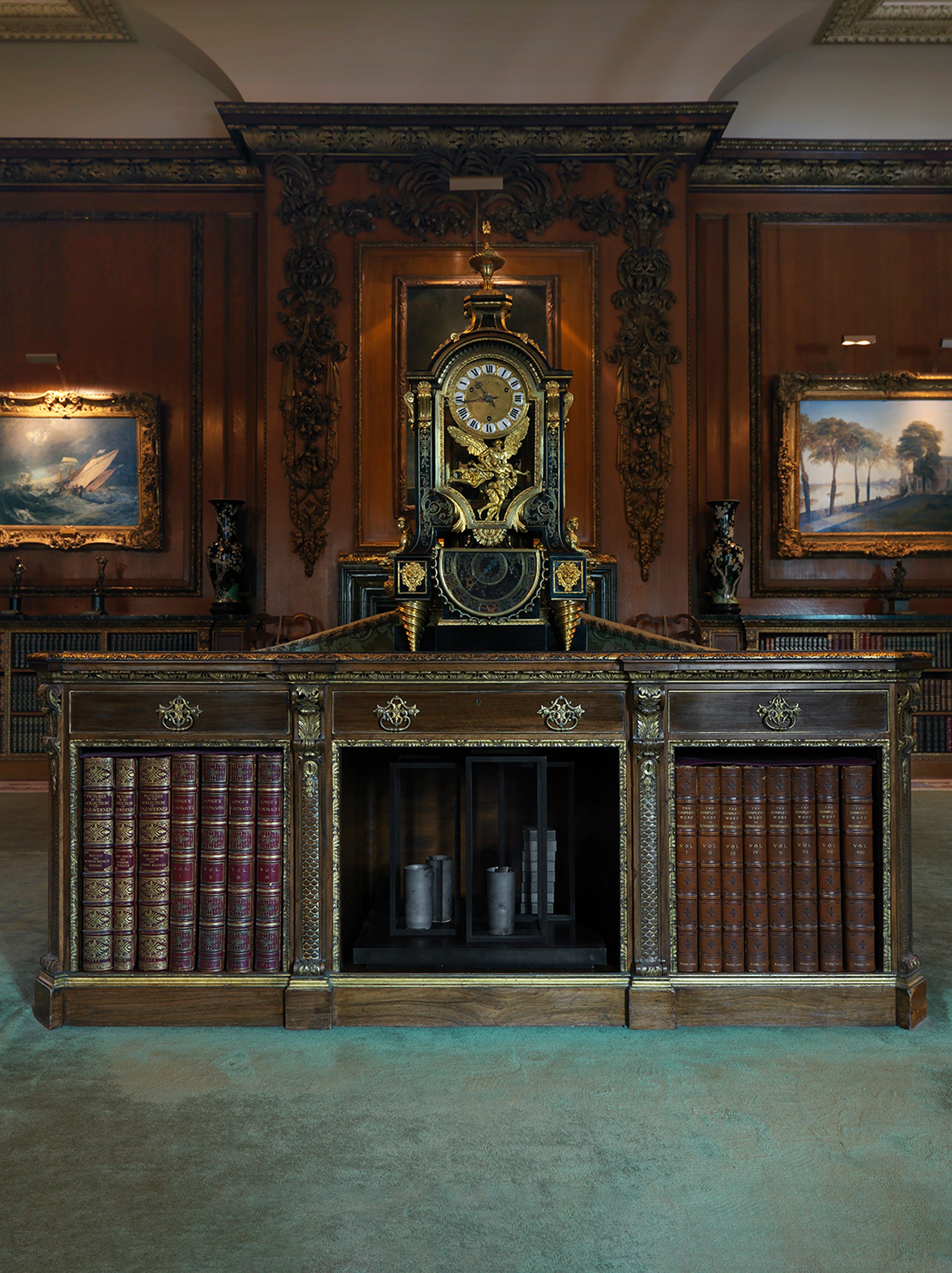
“If, to use a simile,” wrote Walter Benjamin on Goethe’s Elective Affinites, “one views the growing work as a burning funeral pyre, then the commentator stands before it like a chemist, the critic like an alchemist. Whereas, for the former, wood and ash remain the sole objects of his analysis, for the latter only the flame itself preserves an enigma: what is alive.”
It is an enigma. So I take these ten volumes away and make a space that shelters unread books. It is an act of commentary. And then I make four porcelain vessels, break one into shards, stack steel on steel, and replace The Book of Wealth with an alchemy and stand back and hope that this is criticism and there is fire.
Frick loved art. Books not so much.
x
How can you possibly bring anything into the Frick? Surely, the implication hangs in the air, that is lèse-majesté? There is always a pause, and then there is the supplementary question. Is there room? Which means What will you displace?
Hence vitrines.
Vitrines are spaces to hold objects. They contain, they represent, they order a part of the world. They suspend thought between a private and a public space: here is what I care about and it is near you but held a little away. The space within becomes charged: Rilke writes of a “room vibrating like a vitrine.”
The velocity of the world is slowed. This is rest from the commerce of things in transit from place to place.
A vitrine is a holding in the air, an attempt to make something float. You want it to be a gesture, as easy as a hand on a shoulder.
The structure of the vitrine draws a line in the air. It holds the space. It also holds the edge of the picture behind it, the texture of the wall, the moulding of the plasterwork, part of a curtain. It becomes another encounter. Rauschenberg’s White Paintings painted “White on white. The blank is coloured by a supplementary white,” a kind of space in which you are made more aware of the changes of light. John Cage’s 4.33 identified the shape of silence. Tacet he marks three times on the score: three movements of silence. In the shape of the performance we become intensely aware of ambient sound. This is graphic disciplining akin to Mallarme’s “the blankness of the white paper; a significant silence that it/is no less lovely to compose than / verse.”
So I think of his compositional rigour—the ways that he makes us move closer or further away, the way he alters our sense of gravity, of being grounded, or hovering or floating. The way he thinks about the ends of shelves, the end of the line, edges. The ways he returns and repeats. And I think that the white page and the empty vitrine have a great deal in common. That paper and porcelain are kin.
“Obedience to the force of gravity. The greatest sin,” wrote Simone Weil. She is right. We want to lift into the air like smoke, like dust.
Porcelain has been thirty years of my life. I started working in the workshop of an elderly potter when I was twelve. And was given a broom on my first day sweeping the eddying dust at six o’clock after everyone had left. If you are serious, you sweep. If you want to do this, scrape these boards down and clean and prepare for the next day: it is what apprentices do. And the dust catches in my throat. The dust is beautiful. It hazes the air. I sweep and sweep, and by the time I come back from the dustbin with my empty pan, there is more to sweep.
This is the dust of the workshops of Jingdezhen, the dust of the arcanists in the castle in Meissen, the dust of Sèvres and of the backstreets of Stoke-on-Trent. It reaches deep into your lungs. I remember the six-year-old interviewed in 1842: “Father died of cough. They called it decline.”
So you start again. So you go outside and stand on the New York sidewalk in the winter sunshine and think about the tilt of the Polish rider in the saddle and Chardin’s glass of water and about work and about gravity and grace. And what it feels like to be without weight and what it means to be on the ground, here on East 70th Street and Fifth.