library of exile
i
Walking through the great and exhausting run of galleries in the Prado I came across a fifteenth-century painting. Two men kneel next to a fierce small fire feeding it with a pile of books. A book burns, its pages open amongst the flames as a crowd of the well-dressed and pious mill around with a mixture of insouciance and mild interest. Saint Dominic points approvingly. Something is happening, a miracle, a book ascending to heaven. True scripture rises from the fire, is incorruptible. Falsity is reduced to ash, words to dust.
Books and ash. This is trial by fire, the testing of what should survive and what be destroyed that forms a terrible skein across the centuries. It reflects power, the edicts and the sermons and manifestos against heresy, the call to make words clean. It reflects the fear of what is contained in books, the possibilities and alternatives. What makes texts dangerous is their closedness: an affront to those who demand openness and simplicity. Banned books become burned books. Burning brings lucidity, a clear sense of what should be passed on and what is undesirable, unspeakable, unreadable. The books open up as they burn. It is revelation.
And it brings with it the imagery of powerlessness in the midst of crowds.
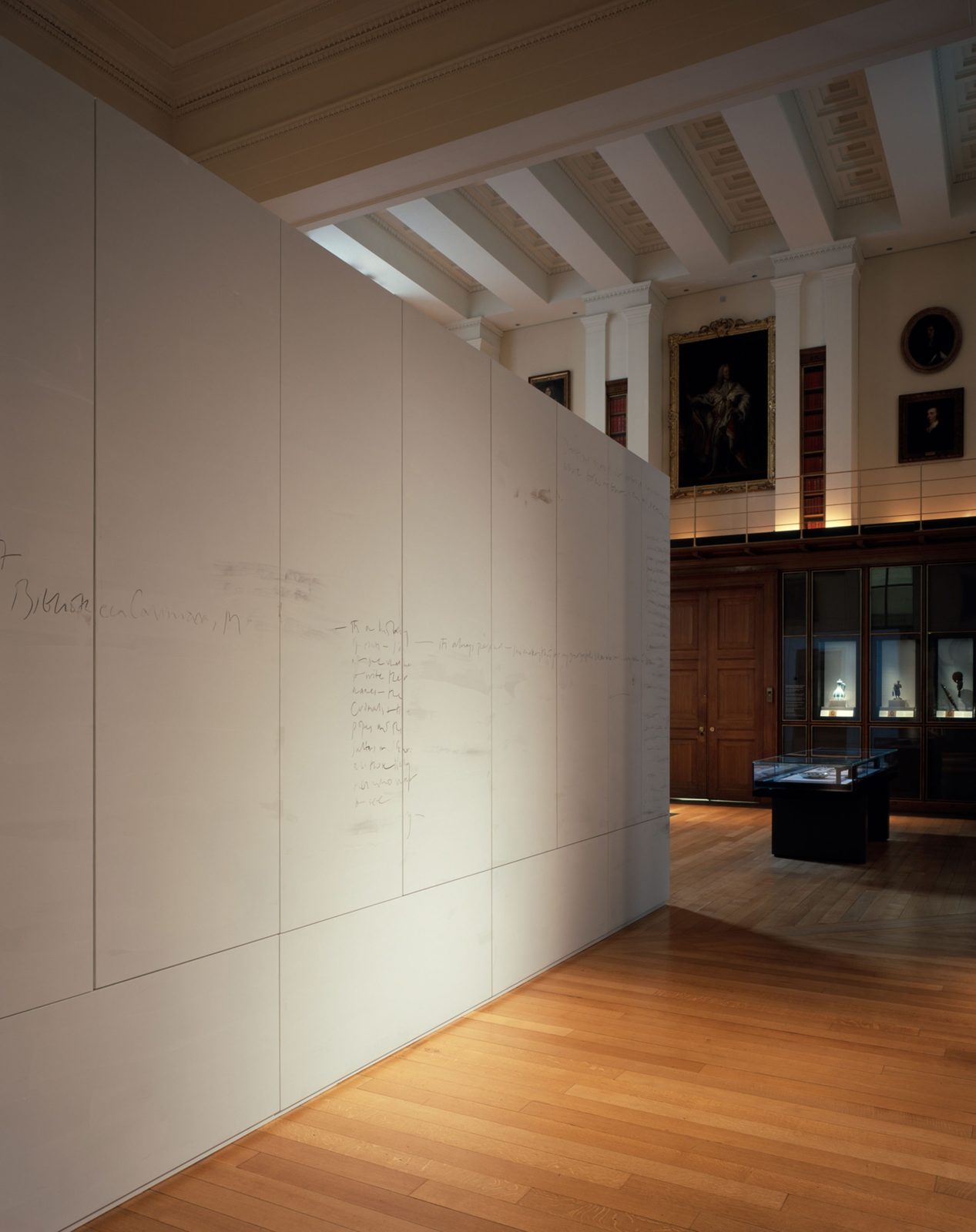
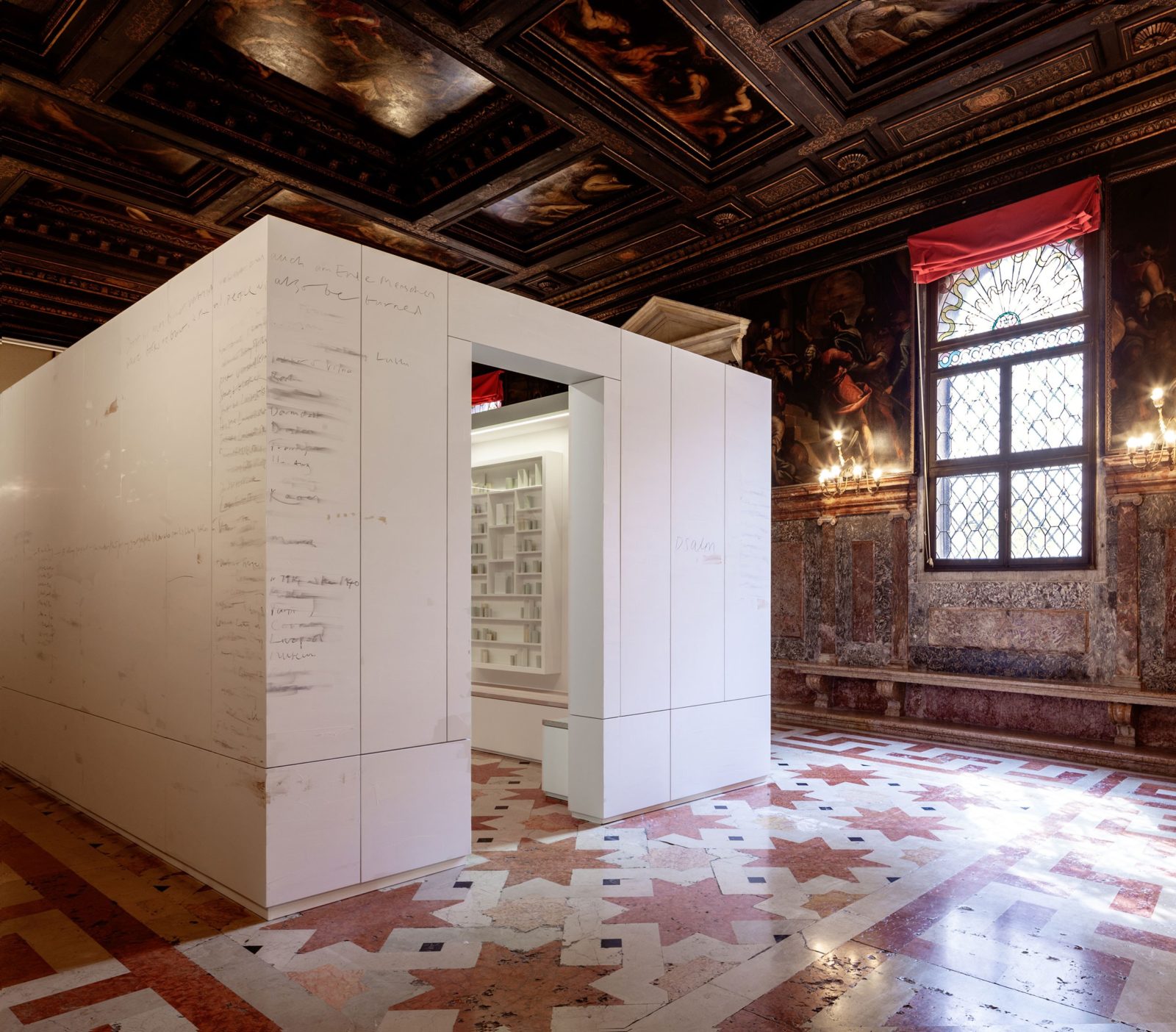
I covered the walls of the library with porcelain slip, a scumbled white surface into which I wrote a list of the lost libraries of the world. It is a threnody.
I start:
‘This is the library of exile
Antioch is the first and then the library of the Serapeum in Alexandria,
and then the library of Al-Hakam, Córdoba
and Rayy burned by Sultan Mahmud of Ghazni
This is the way that Mnemosyne lives
This is the history of lost libraries
The library of Avicenna,
The library of Dar-al-Ilm in Tripoli,
burnt by Crusders 1109
This marks the loss of the University of Nalanda,
And the Bibliotheca Corviniana, Buda,
It’s a history
of edits – I’m
not sure whether
to write their
names – the
cardinals and the
popes and the
sultans and kings and
all those holy
men who want
to see
books burning’
It is always personal. I’m writing this for my Great Grandfather Viktor, who saw his library stolen in Vienna.
Dort wo man Bücher verbrennt, verbrennt man auch am Ende Menschen,’
Where books are burned, in the end, people will also be burned.
These prophetic words of Heinrich Heine are high up on the corner, where I list dozens of the university libraries, city libraries, Rabbinical libraries destroyed in Europe in the Second World War.
At the end of this list I write The Library of the British Museum.
And then I write:
‘This is the history of this century
It’s the National Library of Abkhazia
Pol-i-Khomri Library in Afghanistan
And it’s the libraries of Sarajevo
And all those book-burnings and the
Al Awqaf Library Baghdad,
And the Ahmed Baba Institute in Timbuktu,
And the Saeh Library Tripoli
and its Mosul….’
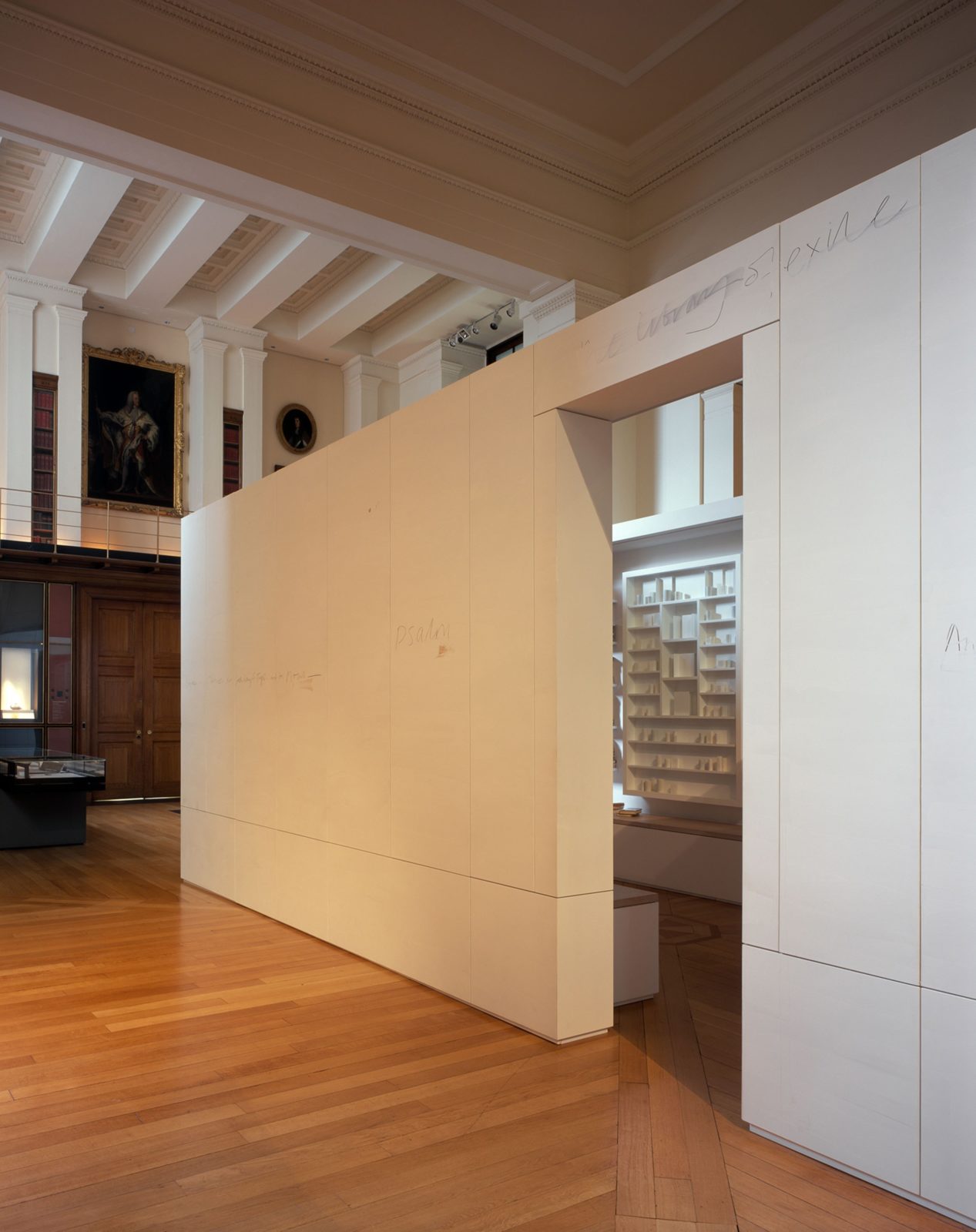
Remembering these losses is way of making their absence into presence. It is about the activity of memory. As I wrote it into the porcelain I smudged some of the names of the libraries, rewrote on top of these and added areas of gold leaf so that there is a shimmer that retreats and appears. This coming and going is how grief works:
‘– I note
On a little scrap of paper the names of those
No longer around me.’ [1]
wrote Bertolt Brecht in his poem ‘Die Verlustliste’ (Casualty List), on the death of his friend Walter Benjamin. It is one exile writing on another exile. He wrote four poems – remarkable, spare texts, inventories or listings of people and places that are lost. This need to name is a kind of collection, a holding in one place of presences and absences. They recall Benjamin’s own obsessional need to record: what epitaph can you write for a recorder of loss? These list-poems have the slightly ragged feeling of a grief that is very present. They feel as if they are unfinished, archival. The text around the library of exile is also unfinished, archival.
The best way of recording lost libraries might be to create a new one. After all there is anger: ‘Every burned book or house enlightens the world; every suppressed or expunged word reverberates through the earth from side to side’ in the words of Ralph Waldo Emerson [2]. And with anger, interlaced deeply with anger, is the reverberation to make a space where all those contaminated, untouchable, dangerous and fissile provocations to those in power can be picked off a shelf and read. And passed on.
ii
The library of exile is a mobile library. It began in Venice. For years I had been thinking of the Ghetto, returning to it repeatedly in a slightly obsessional way. The history is undisputed: it was decreed in 1516 that all the Jews of Venice were to leave their homes and live ‘united’ in the square of houses near San Girolamo in the Cannaregio area of the city. There were to be two gates, opened in the morning at the sound of the bell of San Marco and closed in the evening: the Christian guards were to be paid for by the Jews. New walls were to be built and the canals around this new area were to be patrolled by boats. All Jews who moved to Venice from this moment were required to live here and all the Christian families living in this area were to leave immediately. New Jewish tenants were to pay rent at a rate a third higher. It was to be a place of safety—Venetians were to be safe from the contamination of the Jews. By extension Jews were to be safe from the pogroms.
Sitting in the Ghetto made me think of the great sweep of languages of this place, the mingling of high and low argot and slang, of the dialects of the Armenians, Germans, Flemish, Persian Ottoman, Spanish and Portuguese Jews alongside Italians. This was a place of constant translation, a testing ground for comprehension and nuance, noisy with learning, education, debate, poetry and music, liturgy and exegesis. I thought of the great seventeenth-century Rabbi Leon da Modena who wrote in his autobiography that he had practised twenty-six professions in his life, from teaching both Jewish and non-Jewish students, to serving as a cantor and as a judge, composing poetry for gravestones, translation, printing and arranging marriages. Pleasingly, as I watched some kids playing football, I remember that the issue of ball-playing on the Sabbath was a perpetual debate in the Ghetto.
Everything is still plural here, one history reaching out to another, a palimpsest of voices. When I had the idea of threading an exhibition through some of these spaces, I thought of how the psalms work as songs of exile from the city, the ever-present absence of Jerusalem. The psalms are songs that move between the singular and the plural, the solitary voice and the tribal, anger and despair and lament to joy: ‘By the rivers of Babylon I sat down and wept as I remembered…’. And the psalms are sacred to all three Abrahamic religions, sung and recited and remembered. In making these works I kept recalling Mahmoud Darwish’s Psalms recalling his Palestinian homeland.
So in the spring of 2019 I made installations that were threaded up through the Jewish Museum in the corner of the Ghetto Nuovo. I was given Rilke’s story of an elderly man in the Venice Ghetto and his yearning to move higher and higher: ‘Finally, they were living at such a height that when stepped out of the narrow confines of their apartment onto the flat roof, their heads already reached a level where a new county began, of whose customs the old man spoke in dark words, as though half caught up in the raptures of a psalm.’ [3]
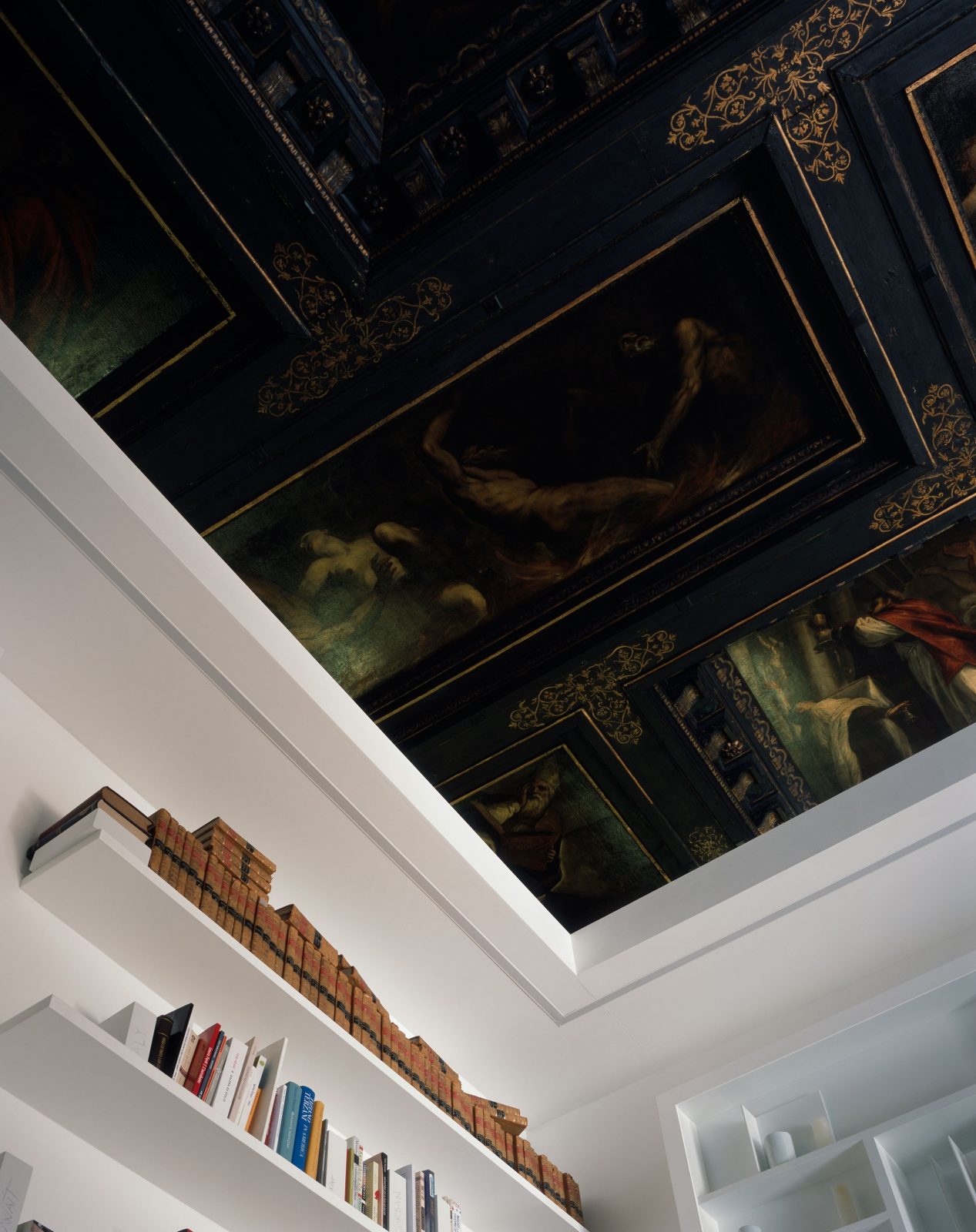
Venice is the city of translation, of a plurality of voices, of language in flux. And of printing. I started to study the beautiful early editions of the Talmud printed here by Daniel Bomberg in the early sixteenth century where he kept Hebrew and Aramaic text and commentary on text alive on a single page. Working with Jewish scholars and copyists he created books that were ordered by distant Jewish communities from Aleppo to Frankfurt. I started to think that I need to create a new library for this city of libraries. Its first place of rest was to be the Aula Magna of the Ateneo Veneto, the sixteenth-century building created to host the confraternities of San Girolamo and Santa Maria della Consolazione and used as a meeting place for debate and reflection over the last two hundred years. It sits in a Campo near La Fenice opera house. A café spreads around it and the world rushes past its great battered green doors. The marble floor dips and rises. The coffered ceiling holds paintings of martyrdoms.
It was April and we kept the doors open to the world. There were four months of events: children’s workshops, poetry readings and music, seminars and lectures and symposia, dance. And thousands of people came and read and wrote and suggested new books for the library. A book was kept open where visitors could write their own experiences of exile. It was filled with testimony by the time we moved on.
In November we opened again in Dresden.
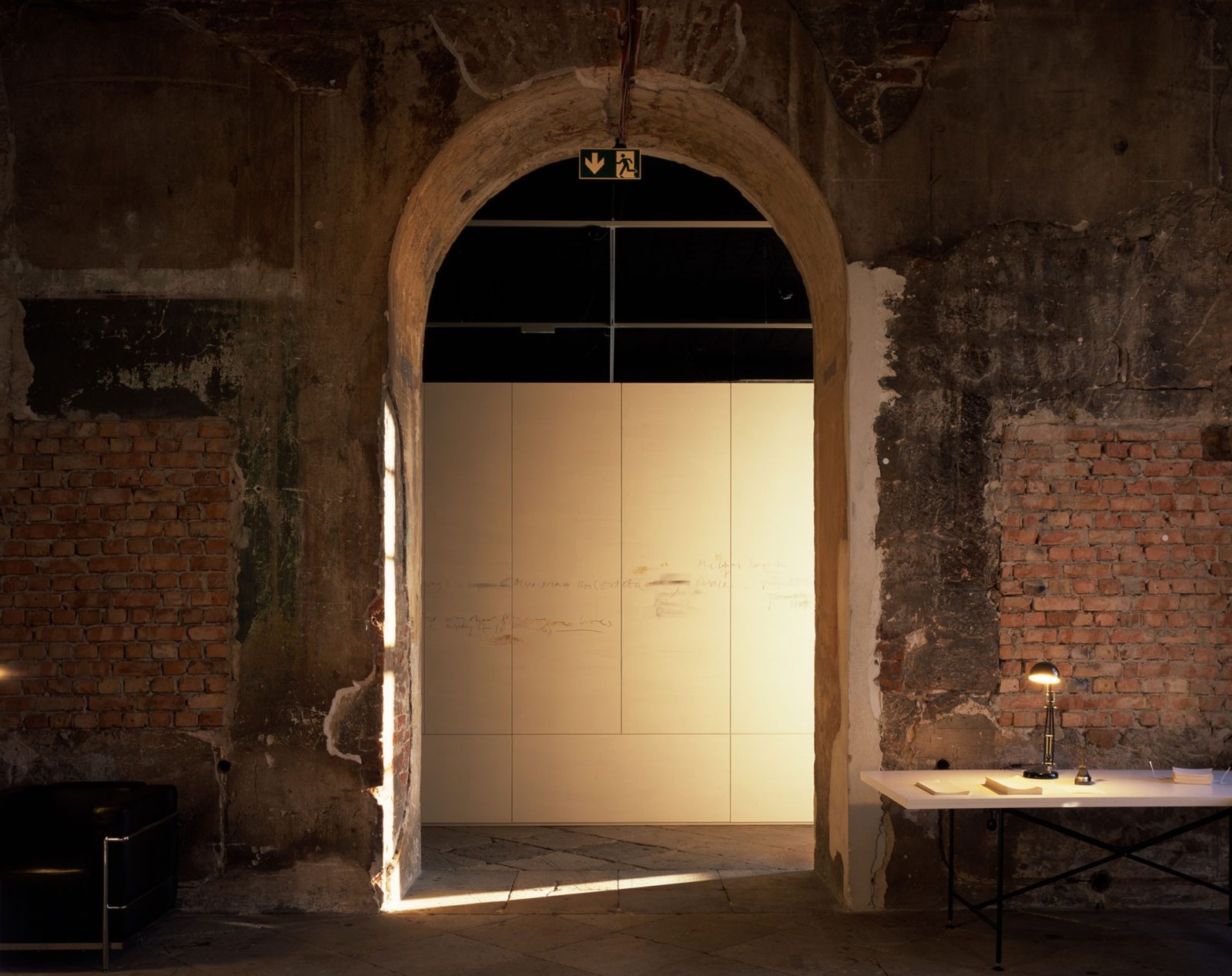
Dresden is the city where the first book burnings took place in 1933 and the city whose great libraries were destroyed in the bombings of February 1945. Here the library was placed in the Japanisches Palais, the vast palace that Augustus the Strong created to house his porcelain collections. Unlike many of the other historic palaces of Dresden that have been restored to their pre-war glory, the Japanisches Palais is unique in still bearing the scars of the destruction. The walls retain some of the painted decoration but floors are scarred and ceilings reinforced with grey concrete. The spaces are palimpsests of the last seventy-five years of history.
And here, in a city whose history is so scarred and whose present-day is so embattled as the centre for the resurgent far right, the library had a very different cadence. Here it felt necessary—a way of reaching out to the new communities arriving from Syria, as well as reaching back to the writers whose books had been burnt here. The reading room we created was the space where Victor von Klemperer studied until he was stripped of his rights to read in a library as a Jew. We had his diaries here.
And the library of exile is now in London, placed in the King’s Library, the storied spaces of the first free library in England, bombed during the Blitz of 1940 and now holding the galleries that reflect the Enlightenment. Here it is in conversation with the great dynamic of language, the Rosetta Stone, the ostraka, those broken Greek shards inscribed with names that sent people into exile.
iii
The library of exile is a collection of two thousand books written by those who have been forced to flee their own country or exiled within them. Writers from ninety countries are included. Dozens of languages are here. And its span is from Ovid’s poems of exile written two millennia ago to the present day—books published by exiled writers this year. You scan the shelves and you see a diasporic world, a settling into language and into translation of multiple geographies: place of beginning, languages of adoption, translation of people. Each library shelf is a question of belonging.
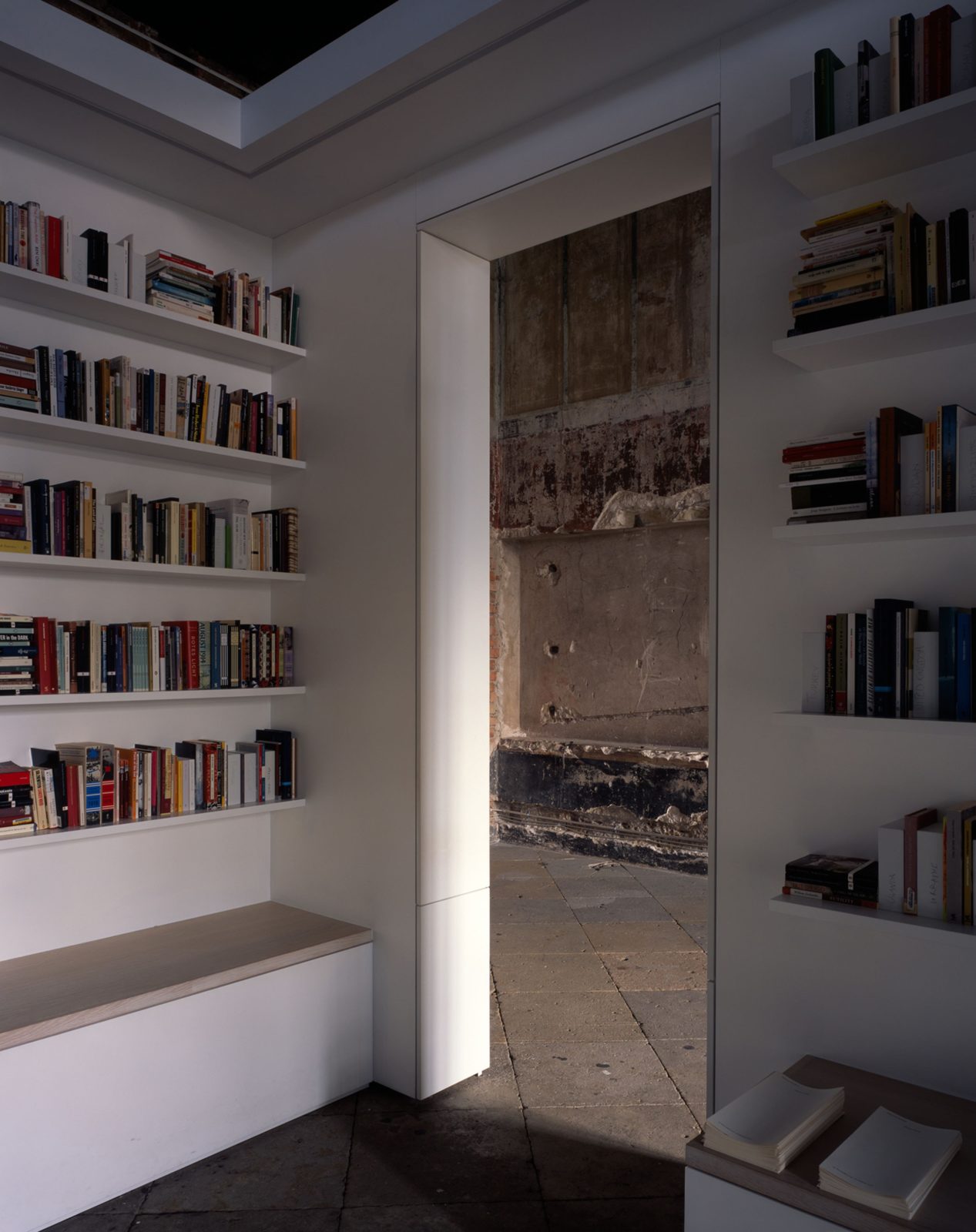
It is always personal. Hundreds of these books come from my own shelves, the poetry of Joseph Brodsky and Osip Mandelstam and Paul Celan, the writings of the German and Austrian diaspora of the 1930s and 40s, the complete works of Voltaire in a beautiful eighteenth-century bindings. And my grandmother Elisabeth’s novel of exile and attempted return, unpublished in her own lifetime. Hundreds more have been recommended, passed on as key, necessary, essential. Wherever they come from each book holds a bookplate: Ex Libris Library of Exile. You reach down a book that matters to you and write your name. Some books have dozens of names, signatures a way of acknowledging significance. To find that all those other people love this novel, that memoir feels extraordinarily intimate. Knowing that when you shelve the book others will write their own names makes it even more personal. Some books are especially beloved, the ex libris plates tipped in one on top of another. Judith Kerr’s The Tiger Who Came to Tea has hundreds of names.
Inside the library is a quartet of installations called psalm, groupings of pale porcelain vessels arrayed amongst pieces of marble. The structures echo the pages of Bomberg’s Talmud. The inner spaces hold shadows, emptiness and space. There are moments of repetition or cadence. These four vitrines are here as places of pause amongst the dense shelves of books. Benjamin’s apprehension that ‘we are alone with particular things, which range about us in their silence...that even the people who haunt our thoughts then partake in this steadfast, confederate silence of things. The collector “stills” his fate. And that means he disappears in the world of memory.’ [4] There is something about the fugitive beauty of the change of light and shadow around porcelain vessels that makes me think of how memory works, how we can navigate the space between the silence of things and the silence of people.
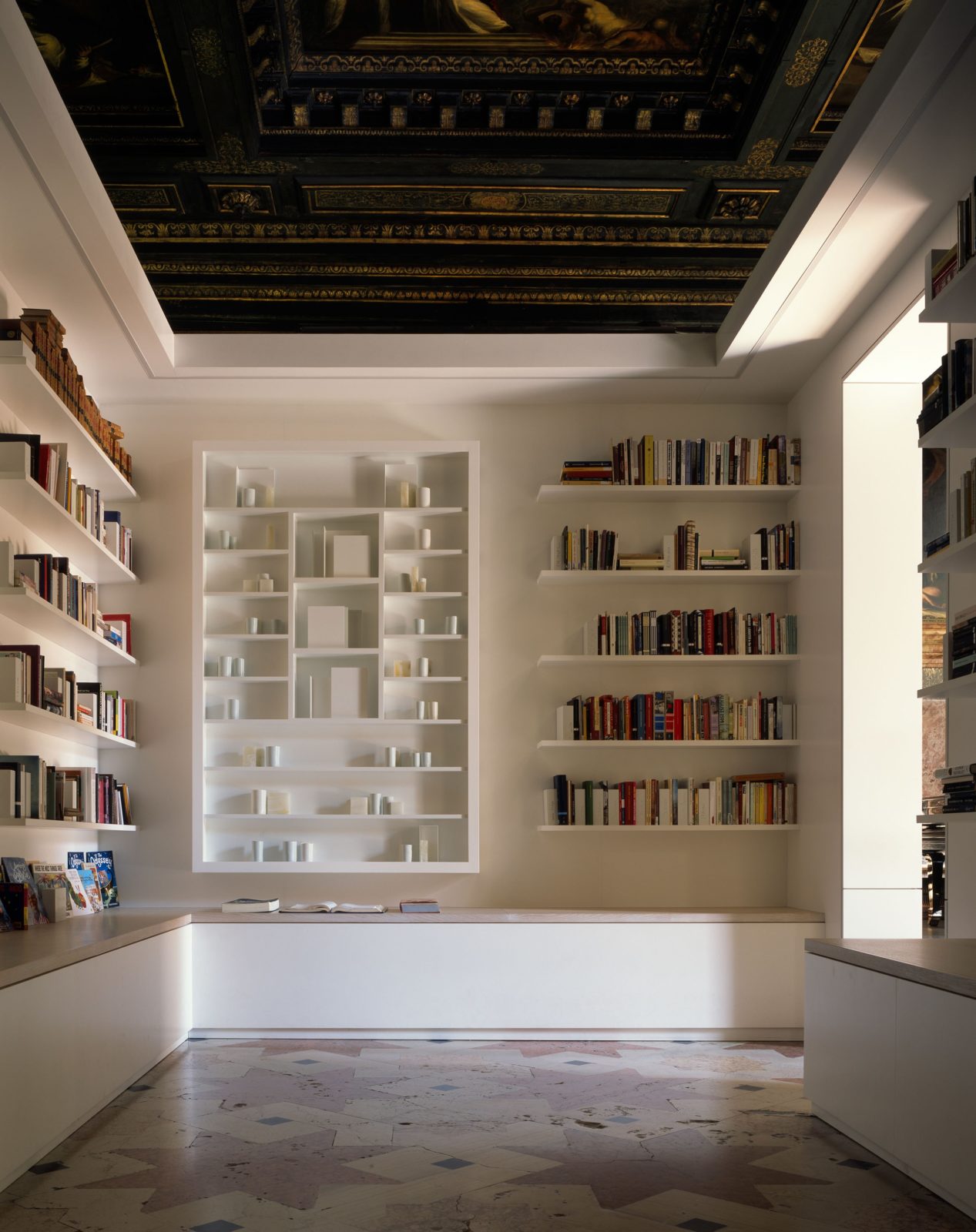
Library spaces are truly complex. They are both personal and social. We are alone with the voices of a writer, but conscious of the polyphony of all the other books, the other readers. To be in a library that so explicitly talks of exile as a condition makes this more painful and more necessary. André Aciman, in exile from Alexandria, writes he is ‘not as a person from a place, but as a person from a place across from that place. You are—and always are—from somewhere else.’ [5]
To understand this, to recognise the somewhere else, is possible here.
After London the books in the library will travel once again. They are to end up in the restored University Library of Mosul. In 2015 Daesh destroyed it, burning over a million books and manuscripts in an act of terrible violence. To be part of the Library’s renaissance, to take books back to a place of destruction, is entirely fitting. And Mosul is a cradle of civilisation, a place of language, of libraries and of writing of the Bablyonian Talmud.
As the Austrian émigré writer Jean Amery wrote in At the Mind’s Limits of his life after Auschwitz: ‘I do not have [clarity] today, and I hope that I never will. Clarification would amount to disposal, settlement of the case, which can then be placed in the files of history. My book is meant to aid in preventing precisely this. For nothing is resolved, nothing is settled, no remembering has become a mere memory.’ [6]
We are surrounded by voices, by remembering.