psalm
My day begins in the Campo di Ghetto Nuovo. It is early morning and I am nursing a cup of coffee and the first of my bag of almond dolci ebraici veneziani, still warm from the bakery. They are rather too good, a hardness that gives way to almond crumbs. It is quiet but I can just make out the sound of the water from the fountain as the children clatter on their way to school and the metal shutters go up across the canal.
This Venetian square is a very special place. There is no church, there are no public buildings, there are no grand thresholds with runs of stairs; everything seems held back, contained. You notice that there are five taller arched windows in one wall, that you can just see a modest domed skylight that indicates the apse of a synagogue. You notice the stone embedded in the wall has a Hebrew inscription from Psalm 32: ‘Many are the sorrows of the wicked, but he who trusts in the Lord, loving kindness shall surround him.’ The tablet high up on the wall commemorates the deportations of 1943. This is the ghetto.
I have been invited here, but I’m not sure what I can bring. Venice in its Biennale months is cacophonous with galleries, parties, and critics, the art world showing off to itself. It is also alive with extraordinary artists.
This place and that world feel a dangerous conjunction. I’m an artist who writes. Much of my work is around the strange contingency of memory: trying to bring particular histories of loss and exile into renewed life. I’ve worked on projects in Berlin and Vienna, but this feels as if there is even more at stake. Being in this place, returning repeatedly, is becoming another obsession.
Trying to navigate the history of the ghetto is complicated. Some facts are undisputed: it was decreed in 1516 that all the Jews of Venice were to leave their homes and live ‘united’ in the square of houses near San Girolamo in the Cannaregio area of the city. There were to be two gates, opened in the morning at the sound of the bell of San Marco and closed in the evening: the Christian guards were to be paid for by the Jews. New walls were to be built and the canals around this new area were to be patrolled by boats. All Jews who moved to Venice from this moment were required to live here, and all the Christian families living in this area were to leave immediately. New Jewish tenants were to pay rent at a rate a third higher. It was to be a place of safety – Venetians were to be safe from contamination by the Jews. By extension, Jews were to be safe from the pogroms that had periodically swept through cities.
Everything else is contended: five centuries of debate about meaning and symbolism, about containment, a powerfully demarcated place of enforced separation, of the guarding of gates, blocking-up of windows, prohibitions and demands. As the Jewish population increased, the housing became denser: houses were subdivided, then divided again, with ceilings in new buildings dramatically lowered, so that a cross-section of the houses looks like an architectural impossibility. The overcrowding was notorious and the buildings were badly constructed, crumbling, dilapidated. It is a place at the very margins of the city: when you look at the great bird’s-eye Renaissance maps of Venice, the ghetto is barely there, tilting off the city into the lagoon. Even the derivation of its name is contentious – possibly from getto, a place where the slag from the neighbouring copper foundry was thrown. The ghetto begins as a place for smelting work, and so, by extension, a place of exchange and transformation.
This place is embedded in metaphor. It is on the edge of the world, it is a place of concentration, a place of powerlessness.
There is another history, other metaphors. Sitting here I think of the great sweep of languages of this place, the mingling of high and low argot and slang, of the dialects and cultures of the German, Flemish, Persian, Ottoman, Spanish, and Portuguese Jews alongside Italians, an almost unimaginable array of clothing, food and music. It was a place of constant translation, a testing ground for comprehension and nuance. It was noisy with learning, education, debate, poetry and music, liturgy and exegesis, with Hebrew as the only common denominator. I think of the great 17th-century Rabbi Leon da Modena, who wrote in his autobiography that he had practised twenty-six professions in his life, from teacher to cantor to judge, to composing poetry for gravestones, translating, printing, and arranging marriages.
Everything is plural here, one history reaching out to another, a palimpsest of voices. And this is where this project finds its core. I thought of how the psalms work as songs of exile from the city, the ever-present absence of Jerusalem. Of how much the psalms work as songs that move between the singular and the plural, the solitary voice and the tribal, anger and despair, lament and joy. And how the psalms are cornerstones of all three Abrahamic traditions.
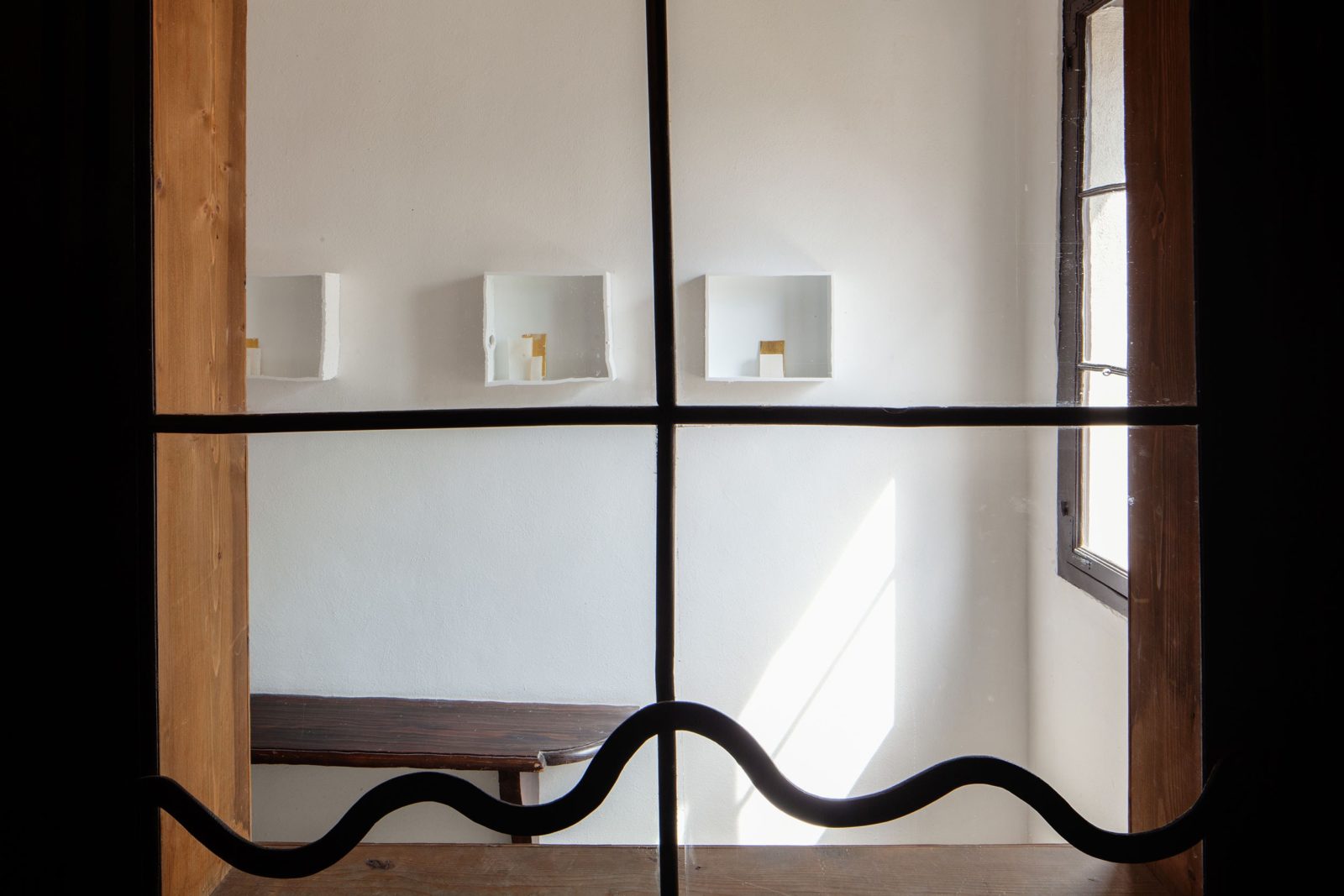
psalm is a series of works installed in the beautiful spaces next to the Schola Canton on the top floors of the Jewish Museum in the corner of the Ghetto Nuovo. According to Talmudic tradition, places of prayer should be high up, should ‘rise over the city’: everything is about the journey upwards, about slowing down. It is firmly not an exhibition; works are placed above you on the turn of the stairs or on the threshold of the synagogue where the long benches allow you to sit. This installation, tehillim—the Hebrew word for psalm—consists of eleven vitrines, each one holding a thin sheet of gilded porcelain of almost unimaginable fragility and a piece of translucent white marble. It is a call-and-response between materials. It is made to catch the reflected light from within the dense and dark goldenness of the synagogue itself.
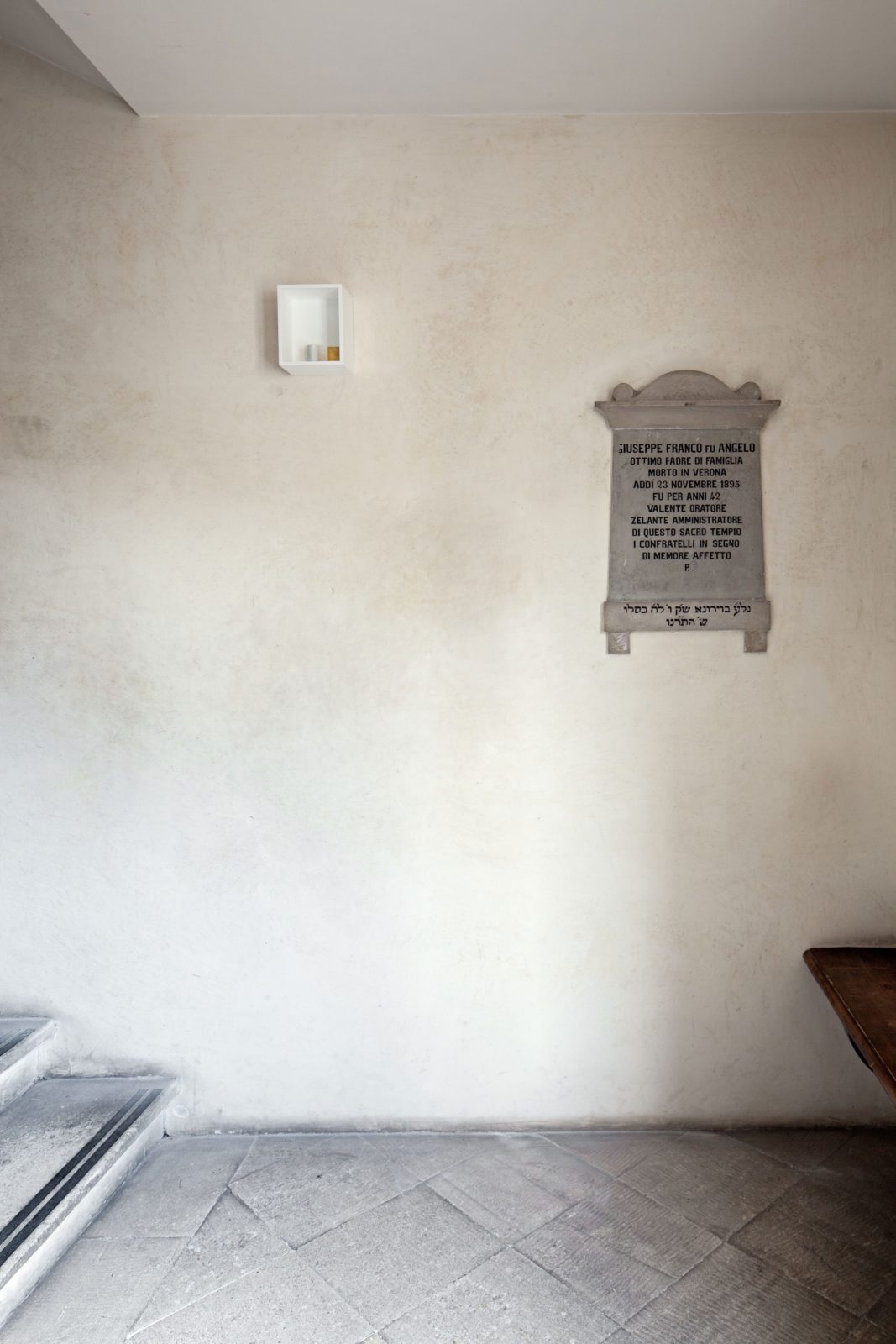
A small installation, Adonai, sits high up on the walls of the staircase. Further up are installations that recall particular poems of elegy and remembrance from Osip Mandelstam, with words scribbled into pieces of porcelain, broken shards collected and held together. Here is a table I’ve made for the Jewish poet Sarra Copia Sullam, who lived and wrote here in the ghetto in the seventeenth century and whose work is being wonderfully brought back to life—most recently in a book of responses by Meena Alexander, Rita Dove and, Esther Schor. I’ve made Sullam her own table into which I’ve inscribed the Latin words of Psalm 137, Super Fluxit Bablyonsis, By the Rivers of Babylon, on and into porcelain slip, brushed over gold leaf. Another palimpsest.
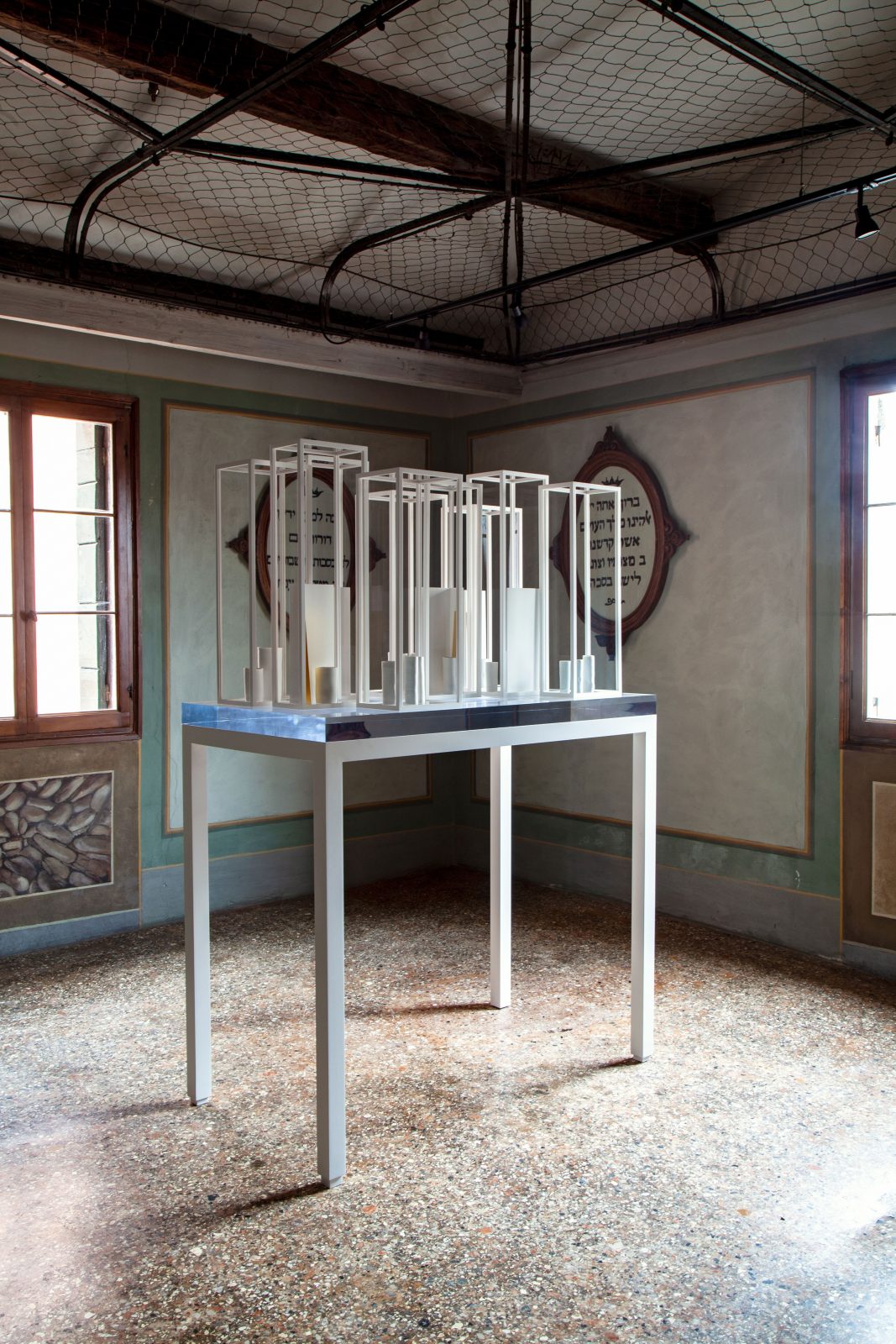
Above this room is the sukkah. Sukkot, the Feast of the Tabernacles, is the festival that commemorates the forty years of wandering in the desert. It is celebrated by taking shelter and eating meals in a sukkah, or temporary structure, often set up in a garden. This was originally open to the air, but retains its metal structure into which fruit and foliage could be woven as decorations. This is a place high up, a memory of a city. I’ve made an installation of porcelain vessels and leaning gold, the vessels held in a kind of sanctuary of towers. I was given Rilke’s story of an elderly man in the Venice ghetto and his yearning to move higher and higher: ‘Finally, they were living at such a height that when they stepped out of the narrow confines of their apartment on to the flat roof, their heads already reached a level where a new county began, of whose customs the old man spoke in dark words, as though half caught up in the raptures of a psalm.’
And, finally, I’ve made a library. It is housed in the Ateneo Veneto, the beautiful sixteenth-century building near the Fenice opera house which has acted as a meeting place for two centuries. I have taken over the Aula Magna room on the ground floor.
Working here in Venice I realise that this whole project was a reflection on the power of translation: the idea that all languages are diasporic, that we need other people’s words, self-definitions, and re-definitions in translation. I remember the words of André Aciman, himself an exile from Alexandria, that he understands himself ‘not as a person from a place, but as a person from a place across from that place. You are—and always are—from somewhere else.’ The ghetto was a place of voices, of language in flux and that this was, in itself, a manifestation of Venice as the powerhouse of printing in Renaissance Europe. This was the city where Daniel Bomberg, a Christian printer from Antwerp, created the great edition of the Bablyonian Talmud in 1519-23. He worked with Jewish scholars and copyists to make books that hold the Hebrew text, an Aramaic translation and commentary within a single page. These beautiful books were ordered by distant Jewish communities from Aleppo to Frankfurt. Venice was the centre of the world. It held the ’somewhere else’ in powerful tension.
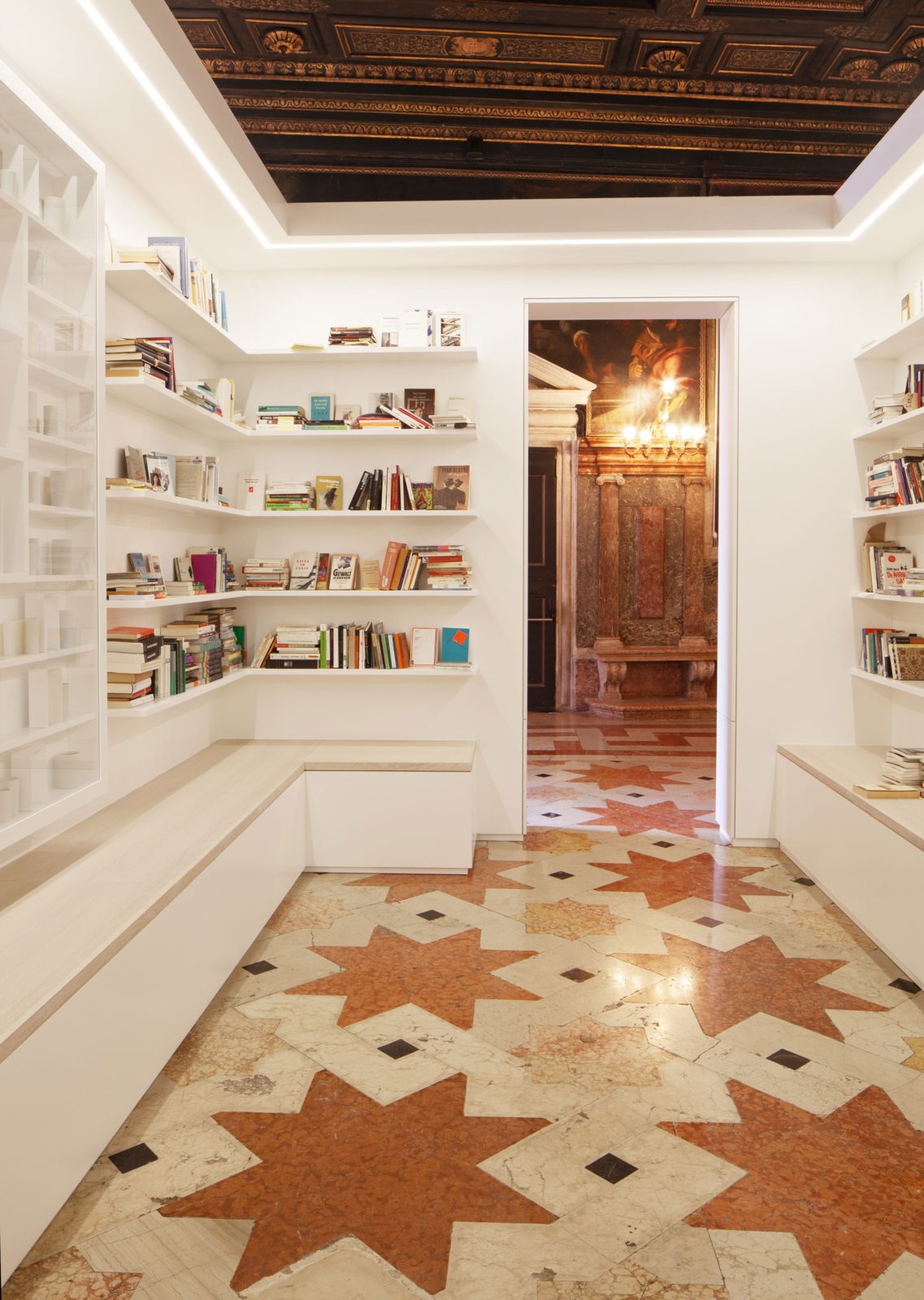
So this is a new library of exile, a place that contains over two thousand books written by those who have been forced to leave their own country, or exiled within it. This is a history from Ovid and Tacitus, through Dante to Voltaire and Victor Hugo. It is the history of the twentieth century, the century of Walter Benjamin and Thomas Mann, of Osip Mandelstam and Marina Tsvetaeva. It is dissidents. It is poets and novelists forced from their homes, Ai Qing in China and Czeslaw Milosz in Poland, Elvira Dones in Albania. I think of the recent decades of extraordinary writers from Lebanon and Syria, Hanan Al-Shaykh and Samar Yazbek, the literature of exile of Iran, Palestine, Tunisia, and Turkey, from Sudan and Somalia, from the altogether elsewhere. It is my grandmother, Elisabeth de Waal. And it is Judith Kerr, whose book The Tiger Who Came to Tea sits low down in the corner of the library within easy reach of every child who visits.
So it includes the works of almost 1,500 writers from eighty-eight countries in dozens of languages. And it is still growing.
The external wall of the library is covered in porcelain, painted in liquid form over sheets of gold on which I have written a new text, a listing of the lost and erased libraries of the world, as threnody.
Antioch is first and then the library of the Serapeum in Alexandria,
and then the library of Al-Hakam, Cordoba and Rayy burned
by Sultan Mahmud of Ghazni
This is the way that Mnemosyne lives
This is the history of lost libraries
The library of Avicenna
The Library of Dar-al-‘ilm in Tripoli,
burnt by crusaders in 1109
This marks the loss of the University of Nalanda,
And on round the walls.
Some words are clear, some effaced by more porcelain slip so that only a shadow is present, some are hazed by gold. I include the Madrasah libraries and the rabbinical libraries of Lublin and Warsaw. Halfway down the long wall I write that ‘it is always personal’ and ‘I’m writing this for my Great-Grandfather Viktor, who saw his library stolen in Vienna.’ High up I write the words of Heine ‘Dort wo man Bücher verbrennt, verbrennt man auch am Ende Menschen,’: ‘Where books are burned, in the end, people will also be burned.’ I list the university libraries destroyed in the Second World War across Europe. And then I start the litany of the last thirty years from Sarajevo to the recent destruction in Timbuktu, Aleppo and Mosul.
Inside this library is psalm, I-V, a quartet of new vitrines whose structure echoes Bomberg’s great Talmudic edition, his way of understanding how you can represent different voices on a single page. Each of these four works holds porcelain vessels and marble and alabaster, placed so that they catch the light.
And then there are the books.
You can reach up and find books that matter to you, have always mattered to you. You scan a shelf and find a literature you did not know. Each book you open holds an Ex Libris label: Ex Libris Library of Exile. You are encouraged to write your name. You find other names, other comments in every book, other stories. Libraries have two rules. One is silence. The other is not to write in a book. In this library there is the hum of recognition, the sight of writing.
Low down are shelves of children’s books. Open these and you find that dozens have inscribed their names, ex libris bookplates lightly stacked on top of each other.
And at the opening Ben Okri stood in the crowd of hundreds and talked of the urgency of exile. And there is the hand on the arm, the urgency of someone telling of their mother, of a poem, of why we need to include X in the library, do I know of Y. That they will bring their children.
It is like a psalm.