School of Life Sunday Sermon
I spent my whole of my childhood listening to sermons, every Sunday and every school day I listened to sermons of all kinds, and I have heard more sermons than any of the rest of you, I can promise you that. And they've been erudite, and they've been embarrassingly hip there's nothing worse than a clergyman trying to be down with the kids. And they've also been very, very, very long. But this is my chance. My father is in the audience. My father is a clergyman. And this, finally, is my chance to preach to my father.
But we've started with Hallelujah, and we started with Leonard Cohen, because that is also part of my childhood. I remember being thirteen, growing up in the deanery in Canterbury, under the shadow of the great Bell Harry, this extraordinary, extraordinary gothic cathedral that loomed over my childhood, and having a bedroom down a very long medieval corridor lined with bearded deans, and playing at full volume Leonard Cohen and trying to work out why I loved Jewish poetry. More of that, anon, but tact. We're here to talk about tact.
And tact is something that I care passionately about. Because this is my sermon, you're going to get Latin, and tact is about touch. You look at the etymology of tact, and all you have there in that beautiful word is the feeling of holding something or touching something, that's the root of tact. So what I want to talk about is touching silence, touching the experience of being with someone and finding a silence in connection with them, because that is what tact is. And I want to do that through talking about my own experience, my own slightly muddled experience, of being someone who makes things with these hands, but also writes books slightly by mistake, completely by mistake. So that's my experience of tact and we'll get there.
But of course, one of the things that we know hugely about is our own experience of tactlessness. And I've been thinking a lot, since the invitation to come and take over your pulpit for you this morning and preach at you, about what it's like to hear and feel the tactlessness of others and the other experience of being tactless, and that awful experience of knowing that you have been tactless, and it's the experience of being bruised or being startled and affronted, of course. But there's also something extraordinary about tactlessness, and I think it's a kind of breathlessness, a kind of invasion of an emotional or spatial sense, a kind of crossing of a boundary, an abbreviation of a social encounter or a conversational encounter. And that is what tactlessness is. It's an abbreviation of something that should be full.
So thresholds, conversation, and art as a threshold, the experience of being welcomed across something and that going wrong. Tactlessness as being the sense of being across a threshold in the wrong way. In limine, lots of Latin here, but liminality, the sense of being on a threshold and it going wrong, that's tactlessness, and we know when it happens. It is an extraordinary and powerful experience of something going wrong. But you know what? Some of the best things are tactless. Some of the greatest art is tactless. Some of the most extraordinary literature is tactless.
We feel energised and invigorated and emboldened when we experience other people's tactlessness to other people, and that's interesting because, and we'll come back to this, but I was thinking about this experience a lot about writing about families and writing about stories, and thinking that the kinds of memoir, the kinds of energetic writing about family life and autobiography through close members of their family that you get in Miranda Sawyer or you get in Bad Blood by Lorna Sage, one of the great, great books the last twenty years, where she talks about her terrifyingly dysfunctional family in a vicarage on the Welsh borders. It is profoundly tactless. She takes apart and eviscerates all those people.
You read these books and they are incredibly powerful because they are tactless. They cross every kind of familial pact they go where they are not supposed to go in the family. And they write as tactless memoirs of an encounter in a family. And when you read it, my God, you're in the grip of this extraordinary sense of crossing a threshold, of doing something, hearing someone saying things they didn't know they could say. It's not tactful, and my God, it's good. Kitty Kelly we'll put to one side, that's slightly different, but there is this extraordinary feeling about how you negotiate tact around different qualities of art.
The experience of tact in my life is both through my making and my writing. What do I do? I make pots. I've made pots all my life, and I was apprenticed from very early on in a great tradition of making pots, the Leach tradition. It's a Japanese tradition brought to life by Bernard Leach, and at the heart of it was this experience of making pots for everyday life that was the heart of the Leach tradition. An experience of that was saying that pots had to be tactful. They had to employ a certain sense of where they belonged in the world in order to fit seamlessly into people's lives. So that you would wake up in the morning and you would reach for your incredibly heavy brown mug, but it would somehow, somehow tactfully come into your life early in the morning, and your whole life wouldn't be punctuated by these brown and green pots, but they would be swept along in this tactful kind of crockery.
It's quite some upbringing, but that was my upbringing, and it was the one which told me that domestic space mattered. At its very heart was this idea of politesse, of politeness, of the tactful place of making pots. It was a disaster for me in lots of ways, because it told me that there was only a certain place where my art could be tackled, in a very small domestic sphere. That I wasn't allowed to raise my voice with what I made and that I internalised for many, many years. It took me a long time to work out that there can be a different kind of tactfulness about what I made, but I grew up with that, that sense, I think, of repression around tact. But actually, my discovery of how I could use space was a discovery that there were different and more energetic kinds of tacts available. I discovered that I was allowed to raise my voice, which I've been doing ever since. But I discovered that what I could do with the kinds of pots I make was to bring them into real conversation with people and spaces and museums and galleries in a much more energetic way. That I could employ my innate tact, my ability to actually understand spaces, but on a substantial scale, and on a larger scale and in different kinds of registers.
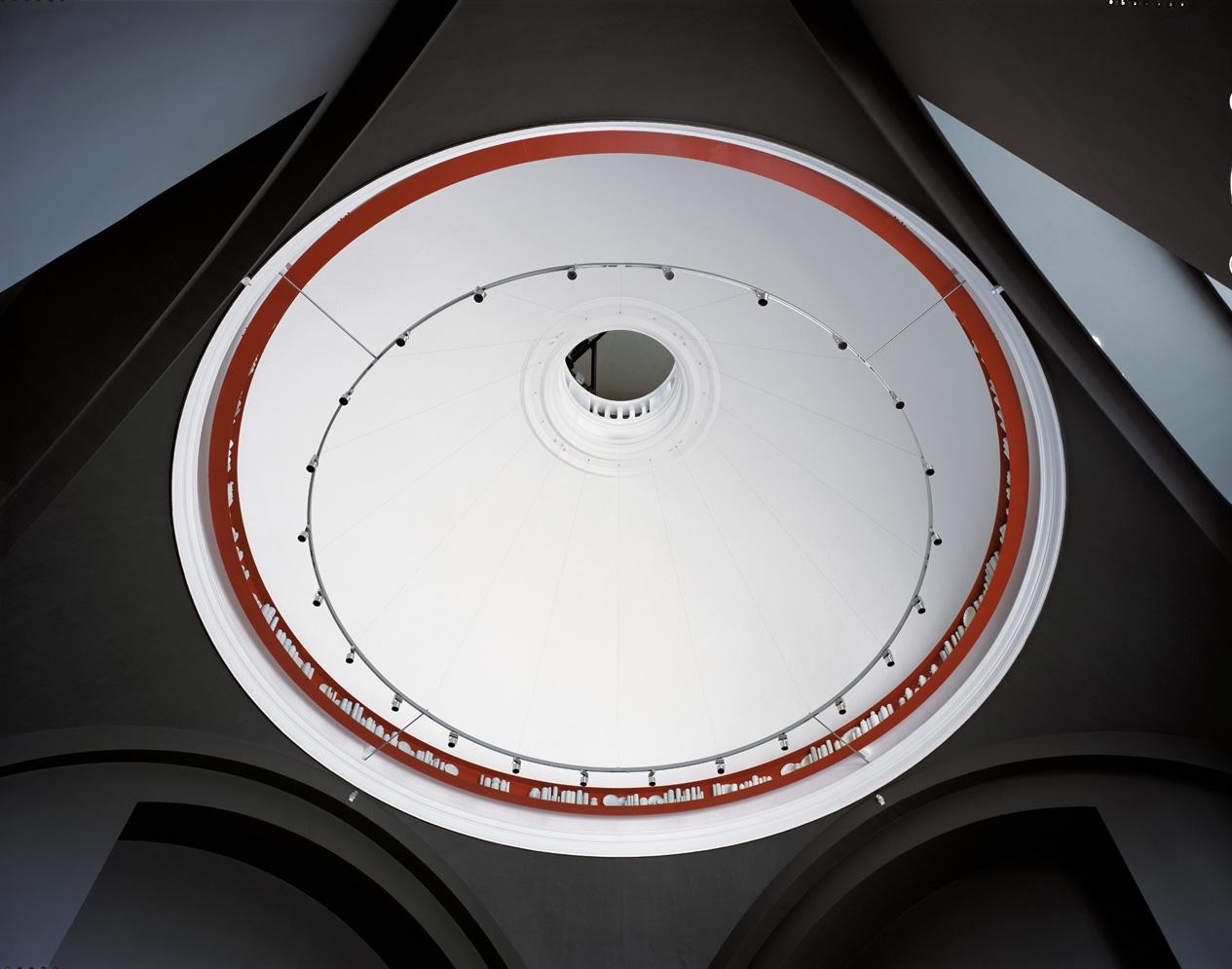
It's not about modesty. Tact isn't about holding things back from a sense of anxiety. It's not about the minor key. It's not about making everything so modest it disappears. It's just not declamatory. And actually, the non-declamatory has a particular kind of power. In my own life as an artist, someone who makes porcelain pots and then brings them into installations, into groups, in different places, I've had to work in some very complicated situations. I've had to work in the V&A, for instance, where there was this wonderful invitation to come and make an installation somewhere in the V&A. And I decided, tactfully, to work seventy feet up in a dome, high above the entrance hall. So when you come in, I don't know if any of you have seen it, you may not have, it's so tactful you may not have seen it. If you come in and get your bag searched, and you take your umbrella away, and you look up, straight up, there's a sort of square about as big as one of these skylights, you look straight up, seventy feet into a dome. And up there, if you get the angle right, there are 452 of my pots held in a huge steel ring, suspended. You can't see all the pots at the same time, they're my own particular version of the pots which are in the V&A. They're my own conversation with this great collection, the greatest collection of porcelain in the world, and they're there, but they occupy a tactful space within the museum. But actually, there are 452 of my blooming pots up there. It's not modest. It's just different.
And a recent invitation to work at Waddesdon exercised tact in a completely different way. Some of you may know it. It's an extraordinary ersatz French chateau in the middle of Buckinghamshire. It's enormous. It's an extraordinary calling card by a French Rothschild 150 years ago, who placed this chateau down in Buckinghamshire and said: I'm here come and see what I am. And the card that he put down on the Buckinghamshire plains was one of incredible collections of porcelain and furniture. Incredible. Everything is gilded. The things that aren't marble are gilded. The things that aren't gilded are Sèvres, and the other things are all master paintings, an extraordinary layering of one thing on top of another on top of another. But what it's saying, extraordinarily, as a place is something about a family belonging or not belonging in English society. How would I work tactfully in that kind of environment you walk in and all you see is gilt. I'm a minimalist, a severe minimalist. I make porcelain pots in all the different hues of white. And so I tried to find spaces within this extraordinary collection in which to make and articulate and punctuate different places of ideas about loss and belonging. And I did that by making vitrines, of porcelain, glass cases, small glass cases, which were then floated on perspex. So they actually float through this whole extraordinary treasure house of 19th century belonging and not belonging.
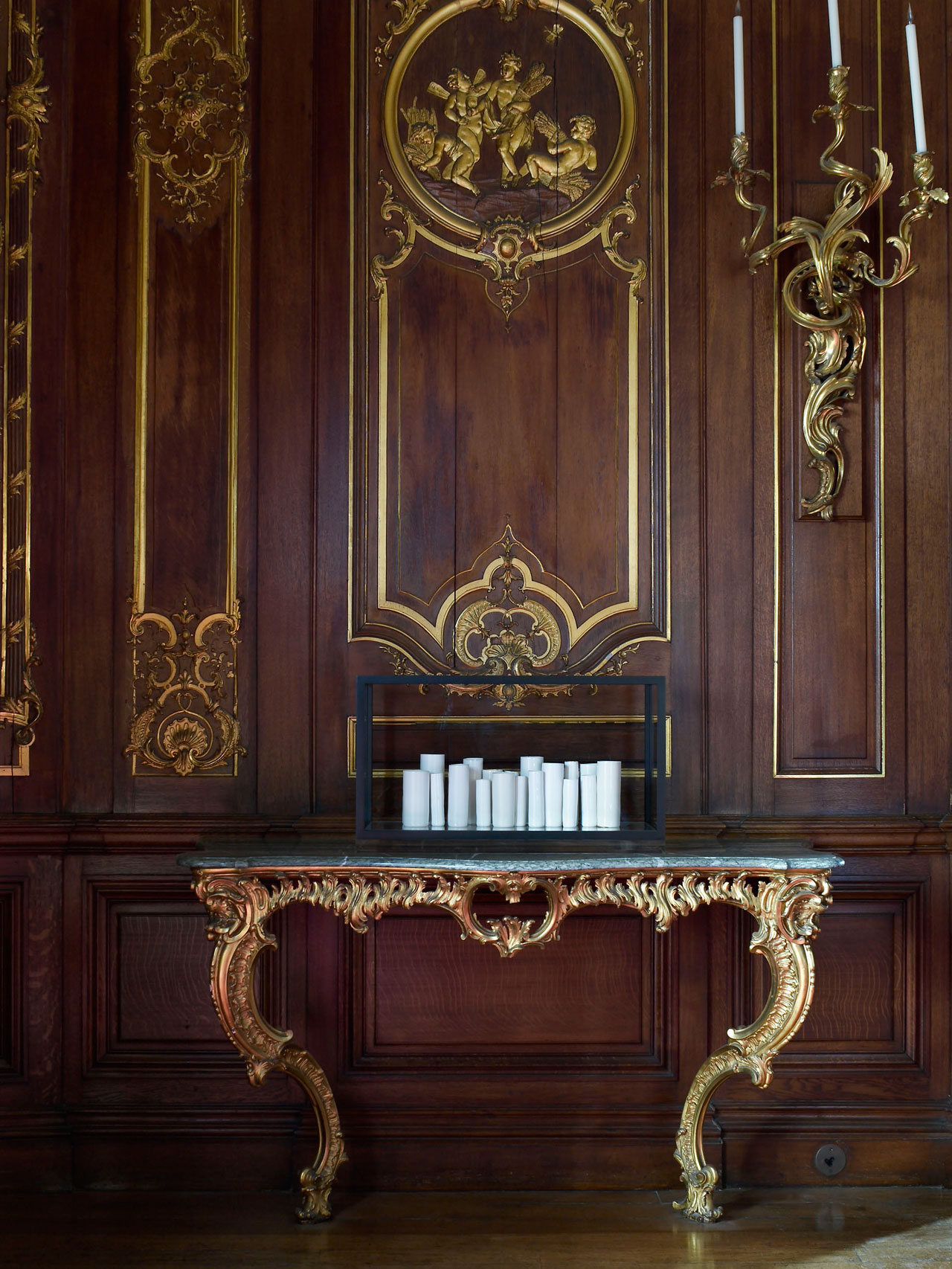
And so it's completely possible, I hope, for someone on their National Trust jolly to come and have their cup of tea in the manor restaurant and go in and not see that I've done anything at all. That would be a joy for me, for someone to be able to walk through the whole of this house and not realise I've been in it, which is a pretty odd aspiration for an artist to have, and perhaps a slightly counter cultural one, but it's an interesting one for me, because actually, what it's about is saying that the kinds of encounter you can have, the kinds of threshold experience you can have as someone who's interested in tact is all about making space for someone to listen and you to be there or not be there in that conversation. So I'm there, if you look hard enough, but I'm not there in a declamatory way. So tact, in my view, is a way of working more slowly. It's a way of building silence and response into your encounter with someone else, or in my case, through my work with a different kind of building.
So that's my first calling card down in my sermon. But I'm conscious that my father always said the best sermons are seven minutes long. As I said, this is my chance to get my own back. It's longer.
Things go wrong for me, things get harder for me, when after thirty years of making things, I find that I am on a parallel journey to try and make sense of my family story. Things go more complicated for me because suddenly I find that I'm writing and researching a book, and I find that I'm trying to work out my own response to tact as I'm on this journey. I find that I'm trying to negotiate in my dealings with writing, how on earth I can begin to tell a story about who I am, about where I come from, and about my relationship with those people I love around me in public. It's really, really, really difficult. It's enormously difficult to write a book about your family.
The first thing I should say, as we're talking about tact, is that no one in your family asks you to write about them, for a very good reason. If you write a family story, if you begin to tell a family story, you are voicing something that belongs to them as well as to you. And that's an extraordinary crossing of a threshold. You're voicing something that they have too, and no one, but no one ever wants you to do that. And in the last few years, I've met many people who have had a similar experience of writing about very complicated family lives and trying to find out a way of staying friends with their siblings having done it.
My own family story is a book and a story which really takes at its heart a series of unvoiced narratives. It's a story about a dynastic Jewish family that disappeared. It's a story about Europe, and it's a story about objects. In approaching it, I had to make a very strong and very clear decision with myself about the way I would approach it, a methodology, a way of thinking about how I would actually approach my story, And I realised that it was all for me about not being nostalgic, about not being melancholy, about not being vague and being absolutely clear with myself, all the way along, that this wasn't about tactfulness in removing myself from the difficult things, the difficult places of silence in my own family story at all. I would say what happened, I would say how it happened, and I would also say about the way it affected me in discovering. It was absolutely about that, but I would also absolutely try and find an exactitude, a non-melancholic, non-nostalgic, non-vague way of being tactful. Of being aware of the thresholds at every point about how my family had been and how I approached them. And that mattered. It mattered in the most blunt sense, because as far as I can see, in every single generation, everyone had very, very complicated emotional lives. Very, very, very complicated emotional lives. One of the great experiences since the book has happened is to discover just how many unexpected French cousins I've got. Really lots and lots and lots of unexpected French cousins. And so on and so on.
Because at every point, if you're writing about your family, you're writing about real people who went through their lives in complex and ordinary ways, but in each position you're talking about identity and sexuality and belonging. How do you do it? Well, with enormous, enormous difficulty. And I find myself at every point facing problems about tact. But this is the very end of the book. I just want to read you two pages, because I've still just about got enough time.
As I fly home from Odessa I feel exhausted by the whole year. I correct myself. It's not a single year, it has become close to two years of looking at the scribbles and the margins of books, the letters used as bookmarks, the photographs of 19th century cousins, the Odessan patents of this and that, the envelopes at the backs of drawers with a few sad aerogrammes. Two years of tracing routes across cities, an old map in one hand, lost.
My fingers are tacky from old paper and from dust. My father keeps finding things. How can he keep finding things in his tiny flat in his courtyard of retired clergymen? He has just found a diary in unreadable German from the 1870s that I now need to get translated. And a week goes by in an archive, and all I have is a list of unread newspapers, a note to look up some correspondence, a question mark about Berlin. My studio is full of novels and books on Japonisme, and I miss my children and I haven't made any pause for him for months and months. I’m anxious about what I'll make when I finally sit down at my wheel with a lump of clay.
A few days in Odesa and now there are more questions than ever before. Where did Gorky buy his netsuke? What was the library like in Odessa in the 1870s? Berdichev was destroyed in the war, but perhaps I should go there too and see what it looks like. Conrad came from Berdichev: perhaps I should read the whole of Conrad.
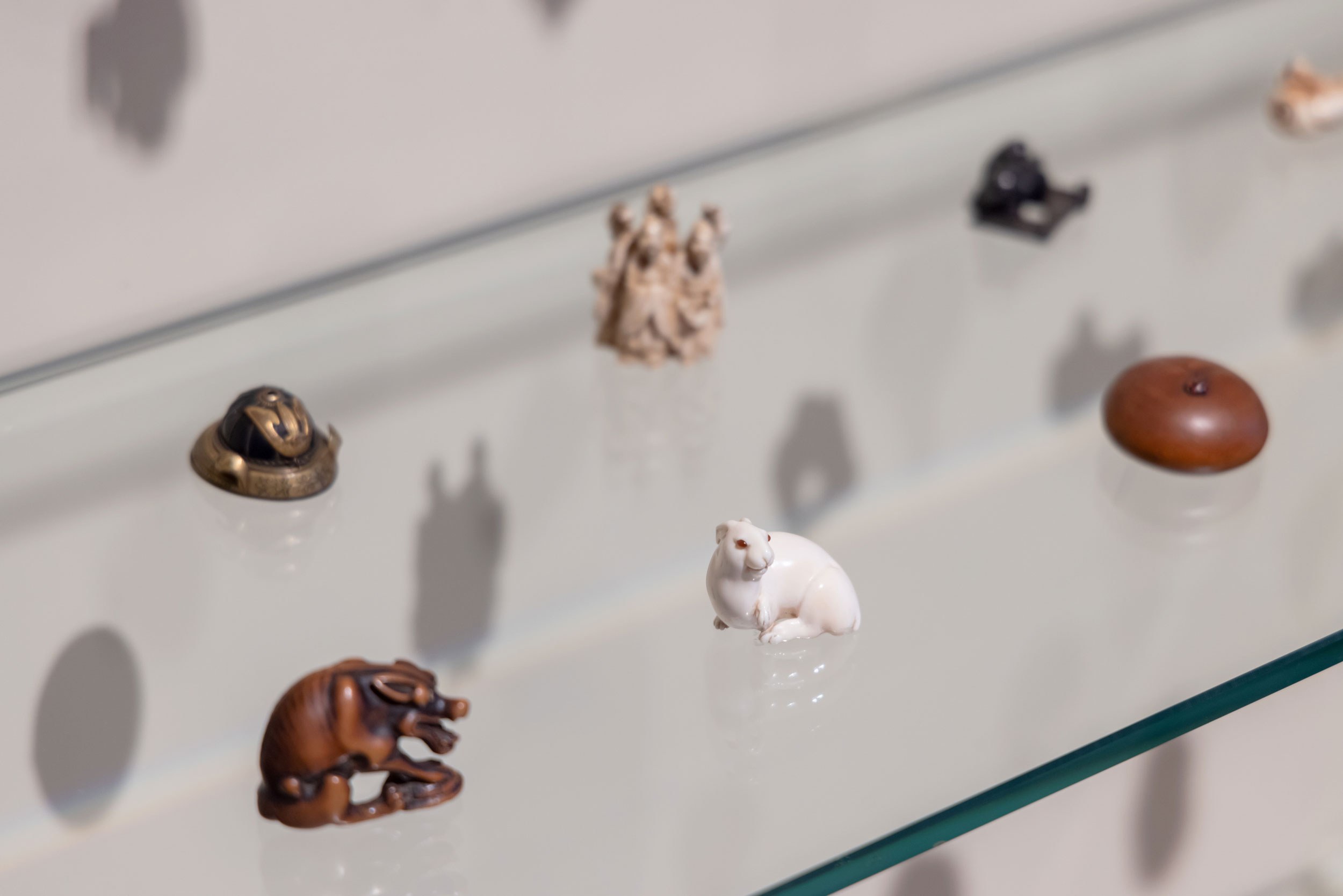
My tiger netsuke comes from Tamba, a village in the mountains west of Kyoto, and I remember an endless bus journey 30 years ago to visit an old potter on a dusty street struggling up a hillside. Perhaps I should trace my tiger home. There must be a cultural history of dust.
My notebook is made up of lists. Yellow / Gold / Red / Yellow armchair / yellow cover Gazette /Yellow Palais / Golden lacquer box / Titian gold Louise's hair / Renoir’s gypsy girl / Vermeer’s view of Delft.
In Prague airport, where I change planes and have three hours to kill, I sit with my notebooks and bottle of beer, and then another, and worry about Berdichev. I remember that Charles, that graceful dancer, was called Le Polonais, the Pole, by both by his brother Ignace and by the dandy Robert de Montesquiou, a great friend of Proust’s. And I have the slightly clammy feeling of biography, the sense of living on the edges of other people's lives without their permission. Let it go. Let it lie. Stop looking and stop picking things up, the voice says insistently. Just go home and leave these stories be.
But leaving be is hard. I remember the hesitances when talking to Iggie in old age; hesitances that trembled into silences, silences that marked places of loss. I remember Charles In his final illness, and the death of Swann and the opening of his heart like a vitrine, his taking out of one memory after another. ‘Even when one is no longer attached to things, it's still something to have been attached to them; because it was always the reasons which other people didn't grasp…’ There are places in memory you do not wish to go with others. In the 1960s my grandmother Elisabeth, so assiduous in her letter-writing, such an advocate for the letter (‘write again, write more fully’) burnt the hundreds of letters and notes she'd received from her poetic grandmother, Evelina.
Not ‘Who would be interested?' But ‘Don't come near this. This is private.’
And in very old age she would not talk of her mother at all. She'd talk about politics and French poetry, and she didn't mention Emmy until she was surprised by a photograph falling out of her prayer book. My father picked it up and she said, matter-of-factly, that it was one of her mother's lovers, and started to talk about the difficulty of those affairs and how compromised she felt by them. And then silence again. There's something about that burning of all those letters that gives me pause: why should everything be made clear and be brought into the light? Why keep things, why archive your intimacies? Why not let thirty years of shared conversation go spiralling in ash up into the air of Tunbridge Wells? Just because you have it does not mean to say you have to pass it on. Losing things can sometimes gain you a space in which to live. I don't miss Vienna, Elisabeth would say, with a lightness in her voice. It was claustrophobic. It was very dark.
She was over 90 when she mentioned that she received rabbinical instruction as a child: ‘I asked my father for permission. He was surprised.’ She was matter-of-fact, as if I already knew.
And when she died two years later my father, the clergyman in the Church of England, born in Amsterdam with a childhood everywhere in Europe, stood in his Benedictine-black, rabbinical-black cassock and recited the Kaddish for his mother in the parish church.
The problem is that I am in the wrong century to burn things. I'm the wrong generation to let it go. I think of a library carefully sorted into boxes. I think of all those careful burnings by others, the systematic erasing of stories, the separations between people and their possessions, and then of people from their families and families from their neighbourhoods. And then their countries.
I think of someone checking a list to make sure that these people were still alive and resident in Vienna, before stamping ‘Sara’ or ‘Israel’ in red over the record of their birth.
If others can be so careful over things that are so important then I must be careful over these objects and their stories. I must get it right, go back, check it again, and walk it again.
How? How? How can you negotiate with tact the silences, one after another across the generations? How can you find a way of tactfully telling the story of people who want their privacy but have a story that is also yours: another generation. How can you find a tactful way of indicating the places where stories fall apart? It matters. You have to find a space, a tactful space of allowing people to have their own stories. In your story, you have to have a way of indicating the threshold. And you can do that in a vitrine, and you can do it in a book, but there's a texture to tact, just as there is a texture and individuality to every single silence.
Tactlessness, I've encountered. The thing about writing a book is you're suddenly exposed out on the stump. And I can tell you, it gets really tough in Denver. Everything's up for grabs. You tell your story. You're jet lagged. You've come all the way and you're not quite sure where you are, and it's Q&A. How much were the pictures worth? How Jewish are you? When did you last go to synagogue? The questions are tactless. They're not tactless by intent, because what you hear is someone in your space wanting to be in conversation with you. It's the abbreviation. It's the abbreviation of the space that happens, and that's tough, and I'm not going back to Denver.