white
White is aura. White is a staging post to look at the world from. White is not neutral; it forces other colours to reveal themselves. It moralises—it is clean when nothing else is clean, it is light when most things are heavy. It is political. It is enmeshed in the world.
It is impossibility. Think of Moby Dick and Captain Ahab, the question crying out, ‘What is this thing of whiteness?’ White is a place to begin and a place to end.
I have spent my life thinking about white. My very first pot, thrown on a potter’s wheel as a child, was white. Forty-five years later I am still making white pots, porcelain vessels. For the last six years I have been travelling to the places in the world where porcelain was created and desired, researching The White Road and writing about the cost of this obsession with white. On my journey I dreamed of the images and objects that mattered to me most. They are here.
This is not an exhibition in a white cube gallery, it is an intervention in the Library and Print Room of the Royal Academy, whose interiors were designed by H.T. Cadbury-Brown RA three decades ago. These rooms were added to the top of Burlington House when the RA moved here in 1868 to house their collection of white marble sculptures and casts.
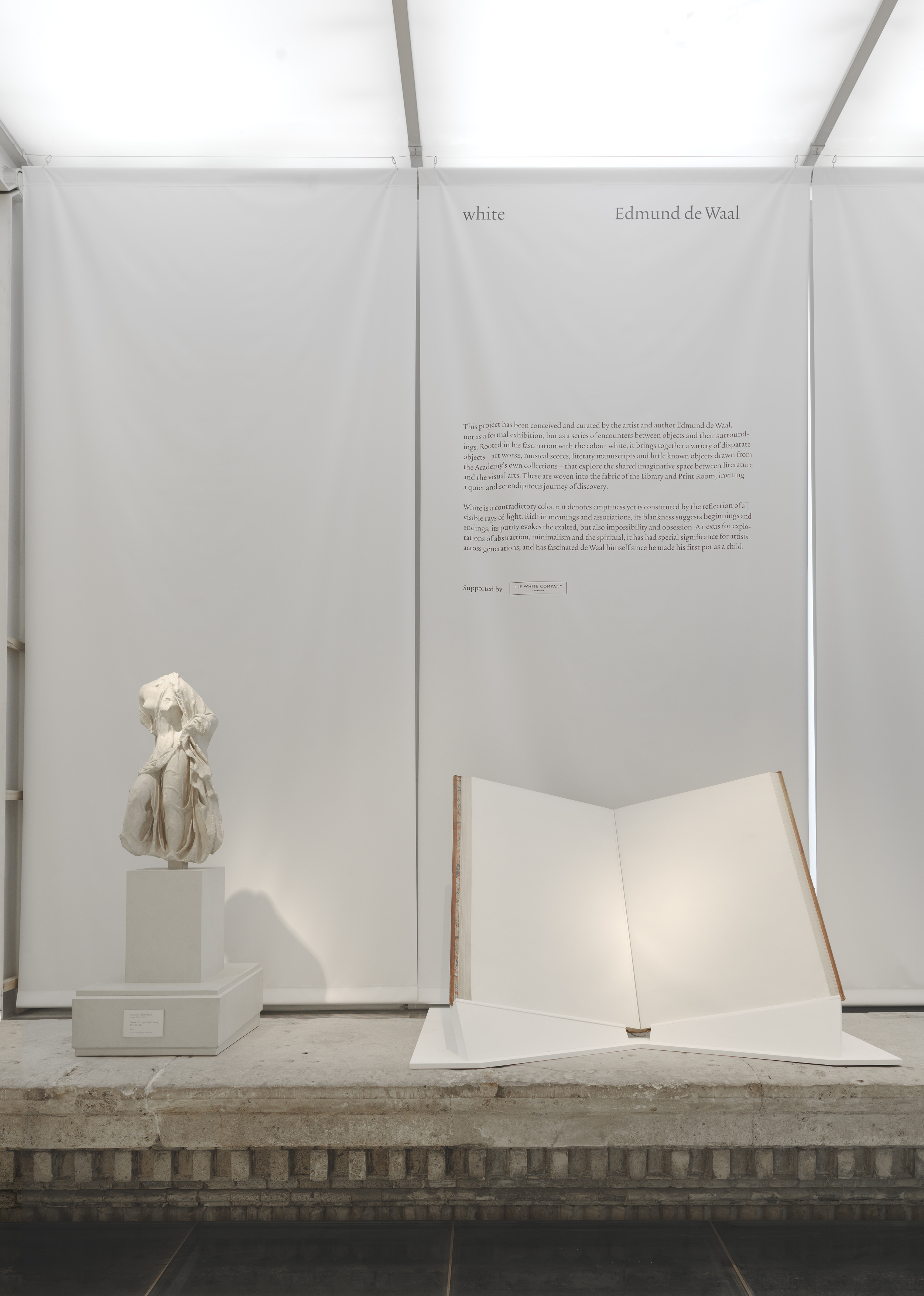
‘White’ brings this early history home. Here are objects that embody memory: a beautiful bust of Ippolita Maria Sforza, a plaster taken from the original fifteenth-century marble, destroyed in the bombing of Berlin; a torso of Europa made in the fourth century BC, a study of flowing cloth over a body; the 1790 life mask of Thomas Banks RA and the death mask of Francis Chantrey RA, from 1841; the porcelain watercolour palette owned by J.M.W. Turner, a stormy sky of colours on a white ground. These rooms are an archive, reliquary, storeroom, memory palace and lumber room for the RA. Here is a nineteenth-century elephant folio of white pages, completely empty. And here is a stack of redundant mounts, kept for two hundred years, waiting. This project endeavours to look at white as both object and experience.
There are vitrines filled with manuscripts, poems and ripostes about white—the white pages of Tristram Shandy, Samuel Beckett, the score for John Cage’s 4’33’’, Rachel Whiteread’s plaster sculpture FOLDED, a lithograph from Josef Albers’ 1966 White Line Squares series. A beautiful Robert Ryman painting from 1998, a vortex of repeated white markings hangs at eye level, demanding you give it time. There are also small works that capture the difficulties of white: an early photographic negative, a Renaissance grisaille illustrating the Visitation of Mary to Elizabeth, an ivory netsuke of a hare. And, crucially for me, one of the first pieces of white porcelain made in the West, a delicate cup from Meissen.
Stepping from the Print Room and into the library itself, some of the shelves of books are displaced by a drawing, a sculpture, or a vitrine. A Giorgio Morandi still life of vessels on a tabletop takes the place of a run of periodicals. Up high is the fragment of a twelfth-century corbel head of a saint. There is a Malevich drawing and photogenic drawings from the mid-nineteenth-century. A marble lantern by Ai Weiwei is juxtaposed with a porcelain table by Amanda Levete Architects: weight and weightlessness. Malevich’s Suprematist Teapot—intensely, angrily pure—sits on a shelf. High above us is a new work by Gary Fabian Miller called It’s Open Clear Light. I have made a couple of vitrines of porcelain to sit near particular books I love. One of these installations is called reminding, trying to remind.
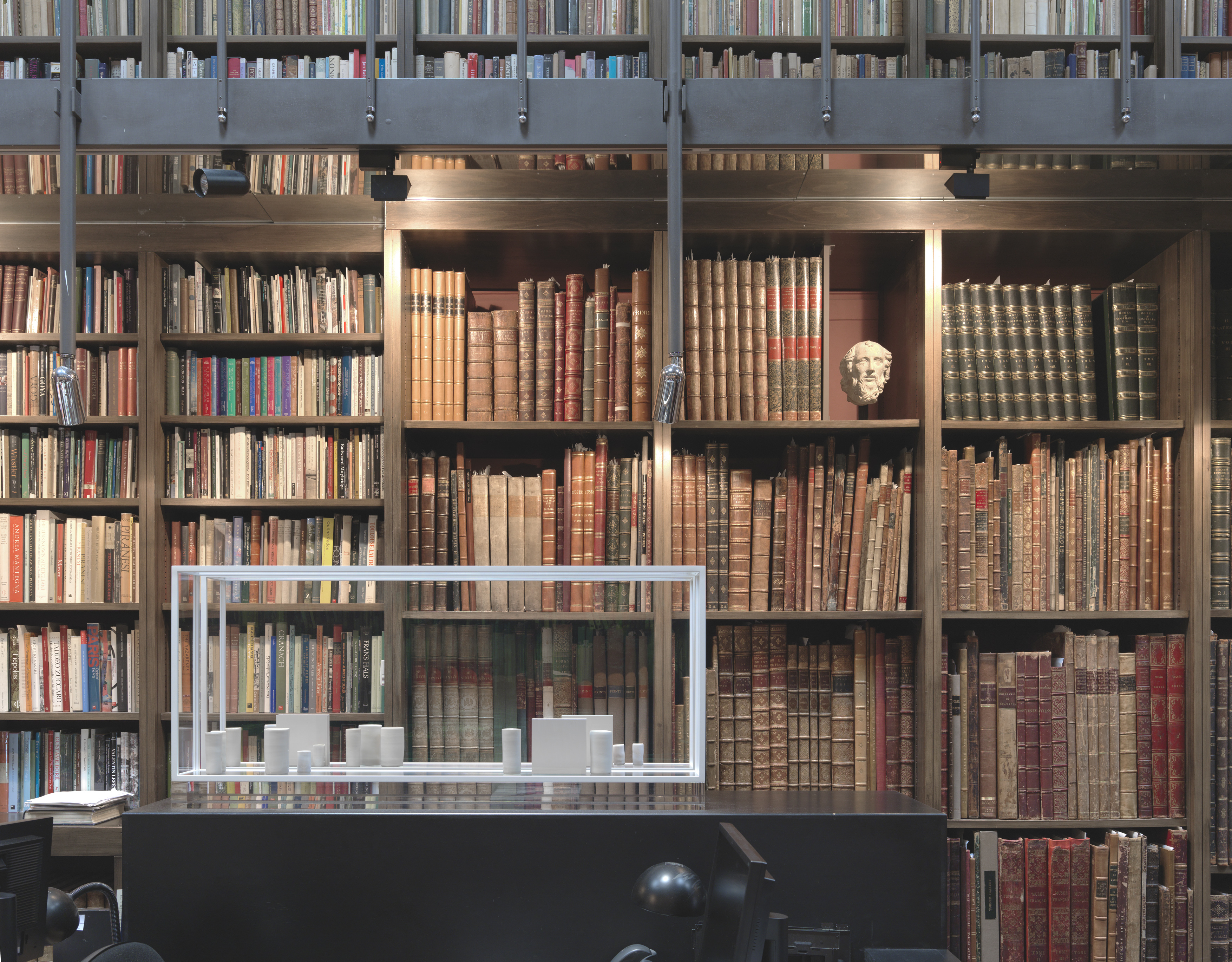
This is an exhibition in a working library, a chance to discover the unexpected in quiet, numinous spaces. It is intended as a journey through things that displace the world through white. Many artists have explored white. There are those for whom white is central and those for whom it has been a moment of symbolic, critical disjuncture. There are artists who have used white as a way of abstracting, of understanding the structure of the world through the removal of the extraneous, and others for whom it is a form of exploring the spiritual. All these are different ways into white, different questions of what white does to the world around it.
There is nothing whiter than a white page, nothing quieter than a library. But as in the score of John Cage, when in silence we are compelled to listen hard to what happens when we stop moving, we look harder when we see white. Because white is a place to start again.
—
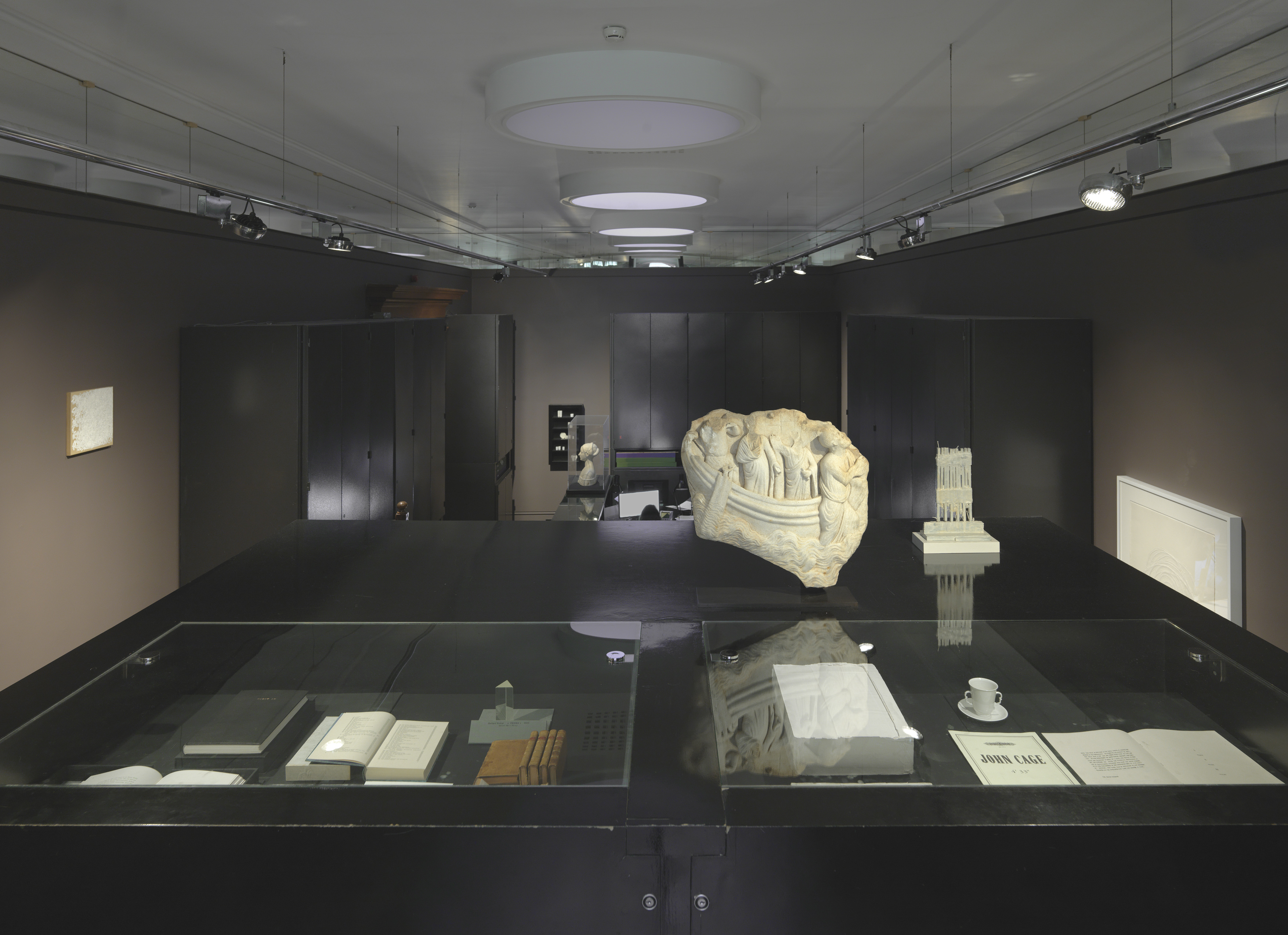
White makes shadows congregate. Classical and medieval sculpture, which we read as pure white expressions of lineament and proportion, once shimmered with colour. Here is a great fourth-century marble fragment of St. Peter walking on the water next to a Cy Twombly sculpture; a broken piece next to a modern assemblage of broken elements. One has become white through age, the other painted white to become archaic. The beautiful sixteenth-century enamel grisaille employs a technique of using greys and whites so that pictures become sculpture. Its size deceives us too.
—
Blank pages in a printed book can be pauses. They can suggest the limits of the unknowable, unsayable. In Tristram Shandy, Sterne uses a black page for a death. These white pages provoke us to paint our own image of the Widow Wadman; ‘to conceive this right, - call for pen and ink – here’s paper ready to your hand. – Sit down, Sir, paint her to your own mind’. Sterne is right. White pages are an invitation. This is my vitrine of manifestos. White has often been a place of polemic, a site for uncomfortable, sometimes dangerous, argument. White can be an invocation for totality. As Wallace Stevens wrote, ‘being visible is being white, / Is being of the solid of the white, the accomplishment / Of an extremist in an exercise...’
—
This cup and saucer are lyrical. Porcelain came from China but was impossible to recreate in Europe until an alchemist and a mathematician cracked the Arcanum, the mystery, in Meissen in 1707. This is one of the first objects made. It is perfectly balanced. But its whiteness is fierce, uncompromising and costly. Cage’s score, 4’33”, is my soundtrack to this exhibition. His performance directions are not so much about silence, but of finding sounds as we pay attention to listening, still ourselves. For me, this is white.
—
In this space there is energy and there is finesse. Here is the skyscape of marks left on J.M.W. Turner’s porcelain palette, an archive of movements. I love this spontaneity, this spirited untidiness shared with the small painting above by Robert Ryman. Ryman has been painting white for forty years, obsessively returning to the colour through different media: ‘White has a tendency to make things visible. With white, you can see more of a nuance; you can see more.’ By contrast the two ivory objects have a tenderness of gesture. I carried this hare for several years. It is intimate, an object of rest and comfort. This mirror back is for the bedroom. It shows a princely game of chess, a courtly ritual of thought and gesture.
—
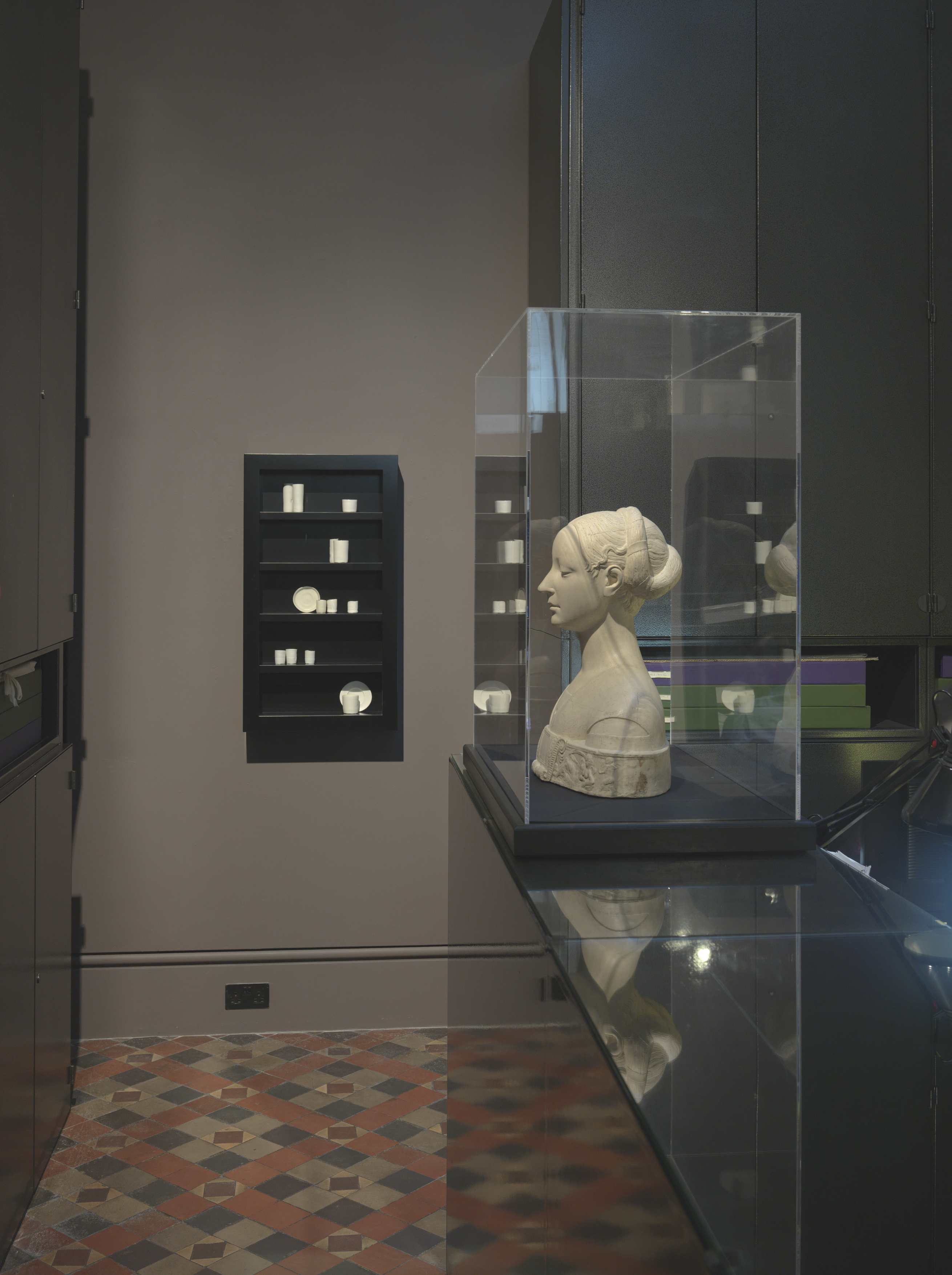
This plaster bust is the only record of the original marble sculpture destroyed in the firestorms of Berlin during the war. It is a ghost. Once these rooms would have been full of marbles and plaster casts for the students to study. It feels good to bring one home. My black vitrine of white objects is also a memory, it recalls my first porcelain pots made thirty years ago. The title is a beautiful steal from Wallace Stevens’ poem, The Snow Man. Darren Almond’s photographs, made using the light of the full moon, often record places of loss - ghostly landscapes of snow and ice.
—
Morandi’s art is one of repetition, a return to the same ceramic objects, shuffled along a tabletop or shelf. They blaze with interiority. The white pot in this painting returns again and again, as distinct as a favourite model. Ai Weiwei’s white lantern is part of his series where everyday objects become hieratic, turned to stone. The fourtheenth-century corbel head of the saint, placed high up on the bookcase, is a tutelary white presence for me, reminding me of a life spent around churches. The two little vitrines, in Berggasse, are my nod to Freud who lived on this Viennese street with objects and books.
—
If you look up you will see an impossible object. It is a porcelain table, a protoype. It floats. It is part of a long story of making objects to defy gravity. Malevich, cussed and brilliant, had to be part of this exhibition. His white squares on white canvas and his invocations—‘The white. Free chasm, infinity, is before us’—make an argument for the meaning of white. His teapot is revolutionary porcelain: a heavy concretion of angles and volumes. The sculpture by John Gibson, ‘life size, of a young warrior wounded attended by a female… nearly finished in marble’ is a reminder that white is open-ended, possibility.
—
This space shows images of people in stone, plaster and light. Lift the cloth covers beside the doorway to find two of the earliest photographic images in existence—a lace cuff and a portrait.
Life masks and death masks bring us back to the history of this place, peopled by artists’ representations of each other, conversations and disputes. Three of the greatest Academicians are here, revealed palely. An alabaster stele from South Arabia is the oldest object in this exhibition, yet has the strongest presence. It stares us down.
—
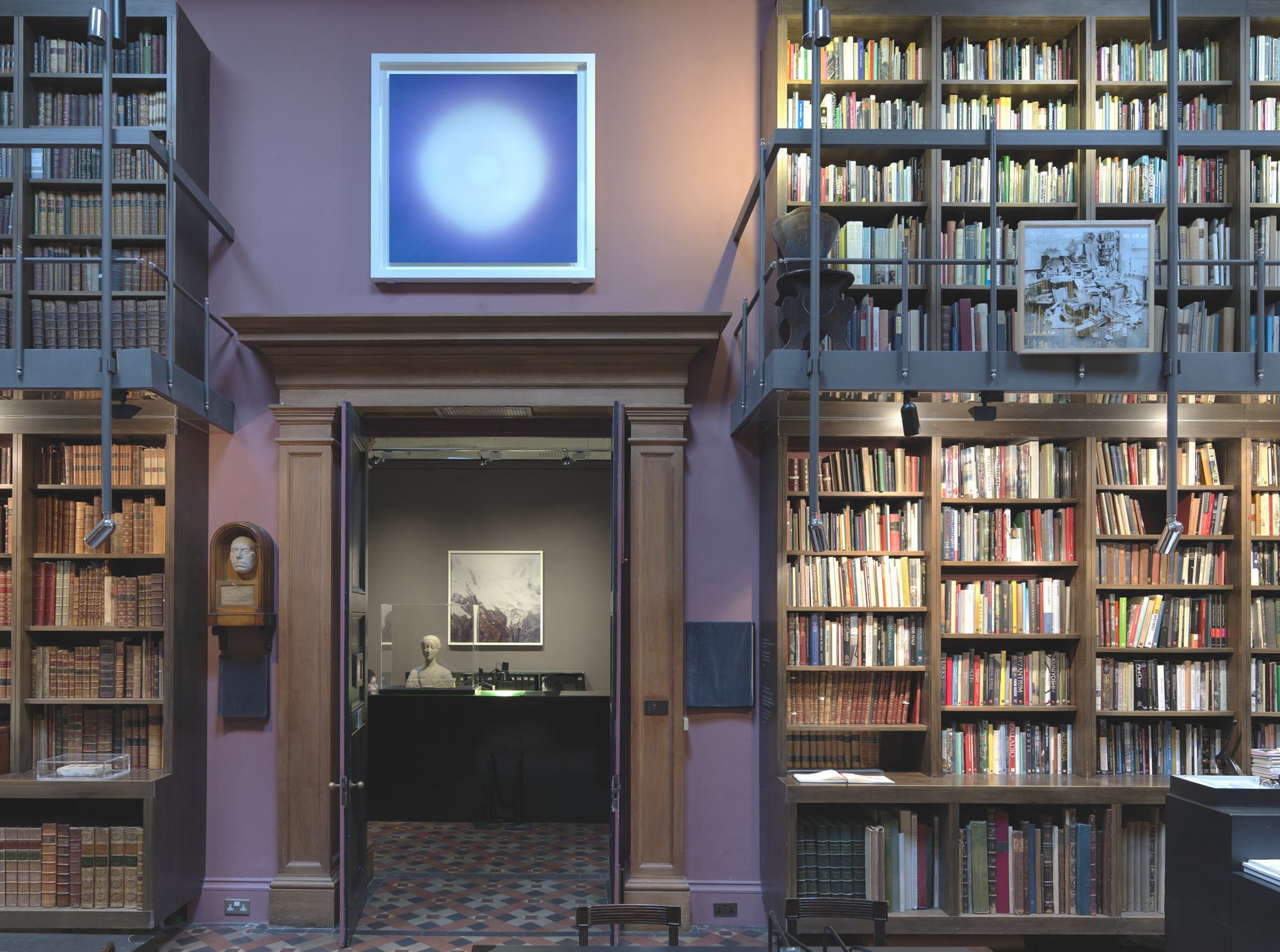
The most recent exhibit is high above us. Garry Fabian Miller works to create images by projecting light through coloured glass and water onto light-sensitive paper. His dark room becomes a camera. A second exposure of white torchlight erases the blue. What is left is a record of different times, different moments, different weather. Keep looking up. Imagine an exhibition only of architectural models, a cityscape of Modernist white. Denys Lasdun, the great British architect, annotates this photograph of models of his National Theatre with correction fluid, creating a complex surface and texture. White can be erasure. It can be addition.