a sort of speech
i
You start writing. You have a sliced strip of newspaper, the torn-out page of a calendar, a visiting card, part of an envelope, part of a postal wrapper from a periodical sent from Prague. You start. You have taken away the punctuation so that words become marks. They are abbreviated to an Assyrian brevity, an Ur alphabet. There is rhythm in these minute angular movements, in this repetition of ticks and scratches. You continue until the scrap of paper is filled, until a space huddled on a margin has a shape. You have made something: a story. It is an artefact. You have filled a space and you have filled time.
‘I am a kind of artisan novelist,’ writes Robert Walser. ‘A writer of novellas I am not. If I am well-disposed, that’s to say, feeling good, I tailor, cobble, weld, plane, knock, hammer, or nail together lines the content of which people understand at once. If you liked, you could call me a writer who goes to work with a lathe… The novel I am constantly writing is always the same one, and it might be described as a variously sliced-up or torn-apart book of myself.’ [1]
How you put things together matters. It can be a table or a shoe or a story or a vessel made from porcelain, the artefact gives the wearer of the shoe, the reader of the story an incontrovertible sense of how it has been put together, of how much space and how much time its creation has occasioned. Something can be done at speed with insouciance or with fastidiousness and deliberation, with focus or with detours, and that does not make it better or more beautiful or more interesting. It is the going to work that matters and what you take with you.
Artisan novelist is good. It reminds me that Welsh bards were called carpenters of song. And ‘taking a lathe’ is intriguing. Lathes remove layer after layer after layer, make something leaner.

ii
‘These detours I’m making serve the end of filling time,’ writes Robert Walser.[2] So nothing happens. He watches children play with a dog and beer mats. A woman looks on from a window.
He listens to the radio for the first time. He hears the sports results from Berlin, some Swiss-German poetry, a cello being played in England. He finds an advertisement for a director’s position in the day’s newspaper. The job requires energy and adroitness and a solid general education. He remembers someone praising him as a ‘successful person’ and his distress at this. ‘I am living here in a sort of hospital room and am using a newspaper to give support to the page in which I write this sketch.’[3] He uses a sheet of a tear-out calendar.
He goes for a drive to see a friend. The driver is a lady. He asks if his smoking offends her. There is a car being repaired by the side of the road. They go through towns and the countryside. The velocity of images comes and goes. He reads a story. They wait at a railway crossing. ‘What I have succeeded in uttering troubles me not in the slightest, since anything I happen to write I soon zealously forget.’[4]
It is prose that doesn’t want to end. The journey can go on and on. Sebald wrote that ‘the detour is, for Walser, a matter of survival.’[5]
iii
Walser looks closely at very small things. He is ‘the clairvoyant of the small’, says Walter Benjamin, himself an obsessive collector of the very small, writer of small texts, maker of small fragments.[6] He does not know that Walser writes even smaller script than him.
Walser has empathy for ash: ‘Ash is modesty, insignificance, and worthlessness personified, and best of all, it’s filled with the conviction that it’s good for nothing. Can one be more unstable, weaker, more wretched than ash? Not very easily. Is there anything more yielding and tolerant? Not likely. Ash has no character and is more removed from any kind of wood than depression is from exuberance.Where there is ash, there is really nothing at all… I doubt I’m very much mistaken if I dare say that we need to open our eyes and look around carefully to see valuable things, if we look at them closely enough and with a certain degree of attention.’[8]
Sebald understands this. Ash is ‘the very last product of combustion, with no more resistance to it… It represents the borderline between being and nothingness. It is a redeemed substance, like dust.’[8]
I ended one book asking if there was a cultural history of dust. In my next book I tried to write one. ‘Obsession costs. Porcelain is a success. Porcelain consumes hills, the wood on the hills, it silts the rivers and clogs the harbours, enters the deltas of your lungs… This, I think, is what I’ve been trying to trace, the glimpse of white rising and then sinking below the waves again, the wind catching eddying white dust, settling and resettling.’[9]
iv
Walser rescued himself from accomplishment. He was a beautiful calligrapher. He started to write everything in pencil.
‘T his pencil method has great meaning for me. The writer of these lines experienced a time when he hideously, frightfully hated his pen, I can’t begin to tell you how sick of it he was; he became an outright idiot the moment he made the least use of it; and to free himself from this pen malaise he began to pencil-sketch, to scribble, to fiddle about. With the aid of my pencil I was better able to play, to write; it seemed this revived my writerly enthusiasm. I can assure you (this all began in Berlin) I suffered a real breakdown in my hand on account of the pen, a sort of cramp from whose clutches I slowly, laboriously freed myself by means of the pencil. A swoon, a cramp, a stupor—these are always both physical and mental. So I experienced a period of disruption that was mirrored, as it were, in my handwriting and its disintegration, and when I copied out the texts from this pencil assignment, I learned again, like a little boy, to write.’[10]
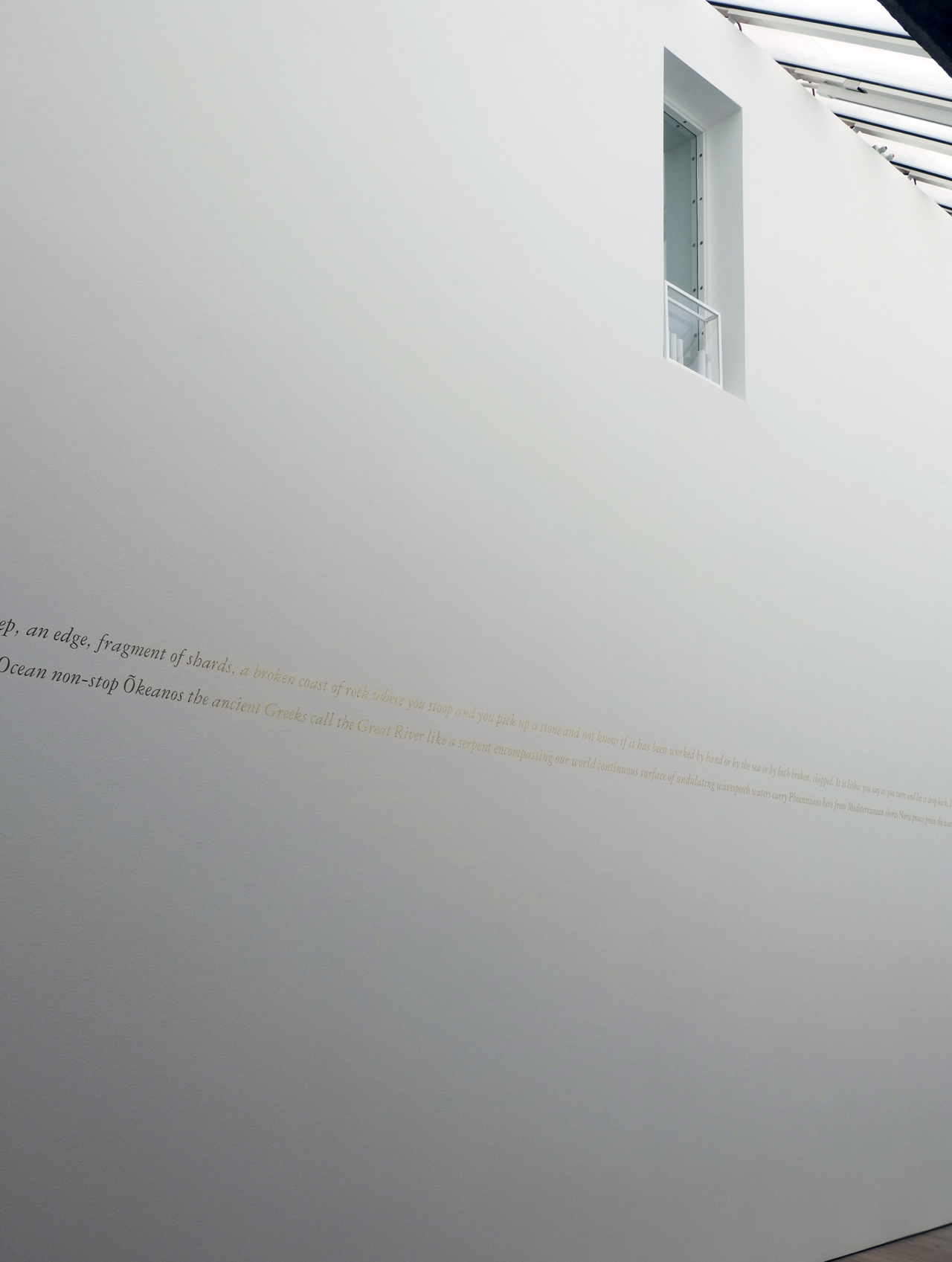
A few years ago I started to write on walls. I loved the slowness of it, the discomfort of holding my arm so high, walking and writing. I wrote a text on a hundred metres of a Stockholm wall, a blindingly whitewashed Ibizan house, a corridor in Margate. I made a golden text with David Ward for the hard light of Orkney.
I covered my library of exile with porcelain slip and wrote a long history of the lost libraries of the world from Alexandria to Mosul, and wrote over the text again and smudged it and crossed it out and began again and made a kind of palimpsest and thought that I am learning, again, how to write.
Words are like ash, like dust, the borderline between being and nothingness.
v
So here is my work. It is a series of detours.
It is a detour through the work of Robert Walser. I love his writings. I love the way he wrote, the way he took apart his accomplishments and made texts. I love his understanding of making as a way of marking time.
Text can be sculpture, sculpture a sort of speech.