Irrkunst
I work with things. I make them, from porcelain. And then I arrange them, find places to put them down, on shelves or within vitrines, in houses and galleries and museums, move them around so that they are in light or in shadow. They are installations, or groupings, or a kind of poetry. They have titles, a phrase or a line that helps them on their way in the world.
And I write about things too, try to give objects the attention that I think they deserve. Those writers who care about this world of things matter to me very much. There are not many. For thirty years I have loved the work of Walter Benjamin, the writer and philosopher and collector. He believed in mapping the world through objects: he collected, amongst many other things, children’s toys, postcards, postage stamps and books, putting things into visitors’ hands, musing over them ‘like a pianist improvising at the keyboard’.[1] He describes the pleasures of opening packing cases of his library and feeling reconnected to his books after many years. His great and obsessive unfinished work on Paris, The Arcades Project, is an attempt to recreate the city through encounters with its material life.

This is my first exhibition in Berlin. It is a city I know best through the writing of Walter Benjamin, a city I am coming to know through walking and retracing particular journeys. Walking is many things. It is a way of thinking: walking alone is always walking in conversation. Benjamin was born here in 1892 and though as a Jewish writer he was forced into exile, leaving to live on the Danish coast, on Ibiza, in Paris, Berlin remains his city. He was also a walker and writes that there is an art to getting lost, Irrkunst: the art of noticing what has been disregarded. Benjamin says that he had ‘a very poor sense of direction...it was thirty years before the distinction between left and right had become visceral to me, and before I had acquired the art of reading a map’.[2] So he wanders. And he sees the ragpicker sorting through rubbish and says about the ‘ragpicker and poet: both are concerned with refuse’.[3] He writes of the Lost and Found office—the Fundbüro—where the detritus of the city is washed up, where its randomness is seen in the juxtapositions of odd objects. He notices that children are ‘irresistibly drawn to debris’,[4] to finding and salvaging parts of the world.
What is disregarded? What can be salvaged?
On foot in Berlin, Benjamin’s Berlin, I walk past the zoo, the school, the café, the library, the apartment, the post office. I follow him. His autobiography told through fragments, A Berlin Childhood around 1900, was ‘written in small sections: a form I am repeatedly led to adopt...by the materially threatened, precarious nature of my work’.[5] He who seeks to approach his own buried past, he wrote later, ‘must conduct himself like a man digging’.[6] His writings are a kind of archaeology. He digs into childhood memories—the way you touch the world first, the way you map your bedroom, apartment, front door, pavement, tram stop, walk to school.
And he conducts himself with care around fragments of text, written on envelopes, scraps of paper, recording aphorisms and quotations, the sayings of his young child, the toys bought from men on the street. He puts ideas aside for later, fills notebooks and index cards, lists his books, his archive. The writer Georg Christoph Lichtenberg loved the idea of a place where all jottings and thoughts and quotations could be accommodated: Sudelbücher, ‘waste-books’. Benjamin loved this capaciousness. He writes under the sign of exile, of displacement, of loss. He cares for the life of things.
He writes in a very small script. This too is a kind of protection.
In fact he is very good at small things. He dragged his friend Gerhard Scholem to see the Shema Israel inscribed on two grains of wheat in the Jewish section of the Musée de Cluny. When I was writing about my lost Jewish family, tracing a history through a collection of very small ivory carvings, Benjamin was my sentinel. There he stood—passionate about collecting stuff, Paris, vitrines, the anatomist of the bourgeois interior—one material covering another. And a man in exile.
Thinking of Benjamin I think of two places as destinations to be discovered on walks through the city: the two gallery spaces of Galerie Max Hetzler, where I am showing this work.
The first is in Bleibtreustraße. The gallery overlooks Benjamin’s school. I look out over the severe architecture and remember him writing of a ‘BELATED CHILD.The clock over the school playground seems as if damaged on his account. The hands stand at: “Late”.’[7]
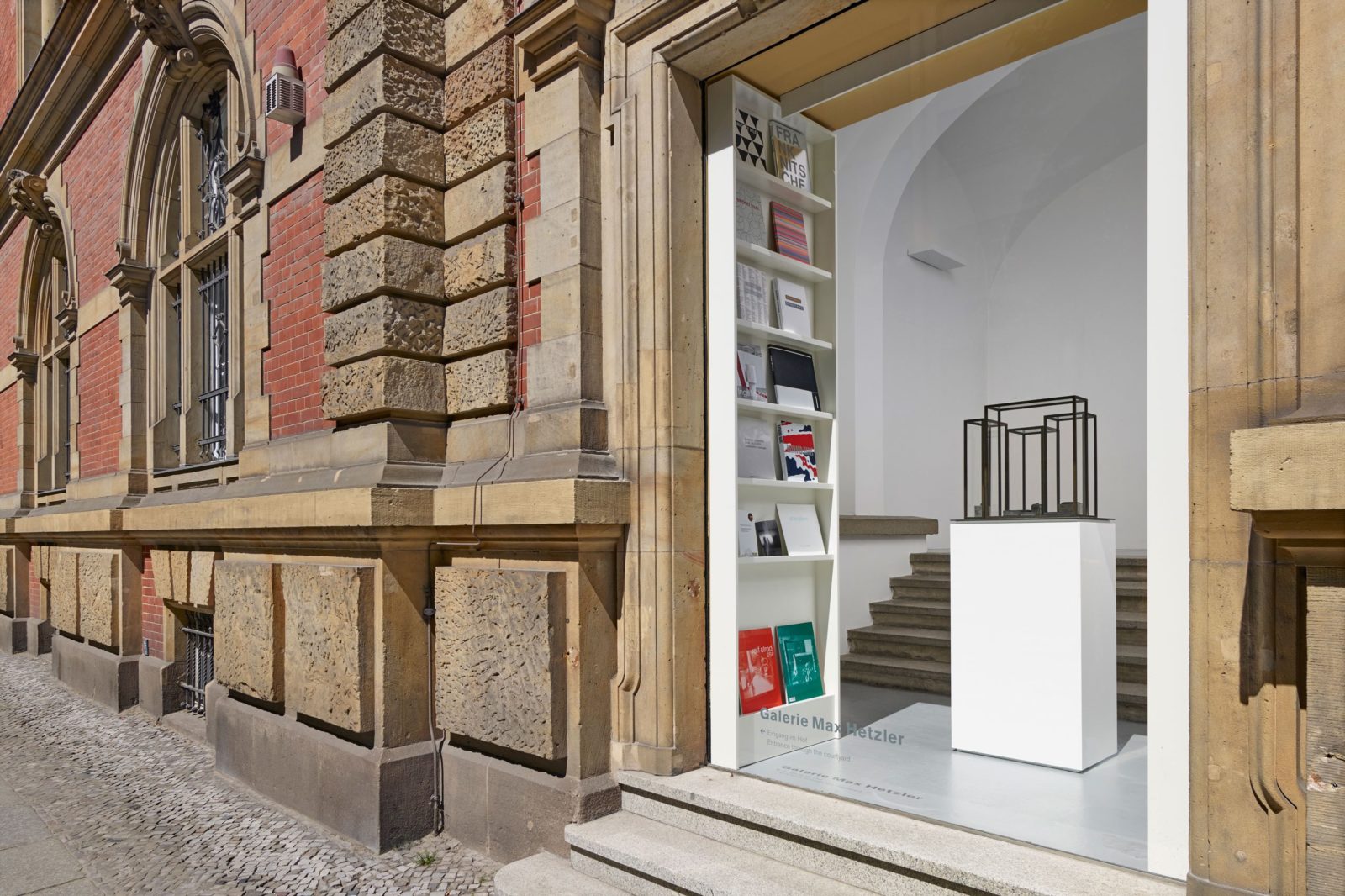
Here is the apartment—the place you work up your ideas, the place where you bring your found objects, arrange them on shelves and cabinets. A place of study. The vitrine and the shelf, the bookcase and the archive. Here is work that reflects my enquiry into making as collecting, collecting as a kind of memory-work. Here is a series of vitrines, places in which my work can pause, vessels and fragments of vessels. There is a room where I have scribbled all my notes on the walls and a cabinet of Benjamin’s texts borrowed from his archive held by the Akademie der Künste. Here are my sudelbücher and my works that reflect on Benjamin as a critic, as a translator. Here is on the eve of departure. What do you take? What do you leave? And a work that I’ve called Portbou, the place where Benjamin took his life, escaping over the mountains from Occupied France into Spain.
The second destination is the gallery in Goethestraße. This, the former sorting office for the post office, is a place for departures. It has echoes. Benjamin was a great writer of letters. Adorno writes, in his introduction to Benjamin’s Correspondence, that letters are ‘what survives the ruin of time’.[8]
I have made three works specifically for this space.
The first is placed in the window: a Berlin chronicle. It holds vessels and broken vessels.
The second is a library. It is a long table and a dozen chairs, lit by four low-hang- ing lamps. The table is covered in maps of Berlin from 1903, when Benjamin would have been eleven years old. There are pencils, paper, envelopes and embossing stamps that you press down to imprint archiv. There are postage stamps nearby should you wish to send a letter. And on a long, low shelf there are editions of Benjamin’s writings in German, English, French, Italian, Spanish, Dutch, Japanese, Russian, Turkish. I think of all the cities in which they were published. I think of his journeying, his cities that he mapped with such obsession—Paris, Moscow, Marseilles. The cities in which he bought his books—Riga, Naples, Munich, Danzig, Moscow, Florence, Basel, Paris. And the cities he never reached. He writes to Adorno that he glances ‘at the city plan of NewYork...and I walk up and down the long street on the Hudson where your house is’.[9] I think of him unpacking his own library with such care.

It is a place to sit for a few minutes or for a few hours, read or write a letter or talk. Or draw. Or trace a route through a city. Not a quiet library; one where lots of voices surround his voice.
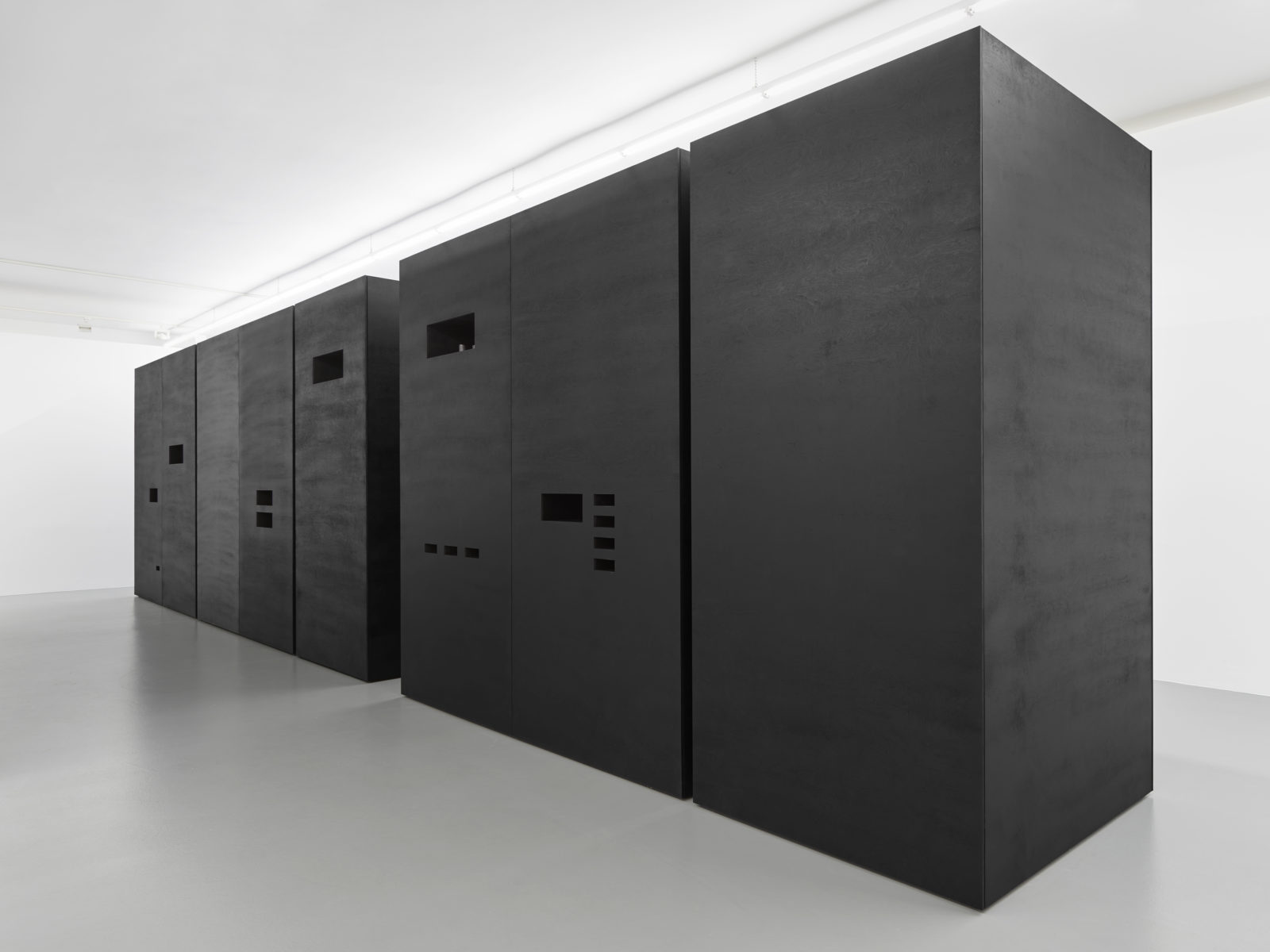
And the third work is Irrkunst. It is very large: a series of small wooden buildings, three metres high, stained a deep black. You can see how it is constructed. It is as simple as a packing crate. And there are interstices, spaces within it. Light comes into some spaces, not into others. There are shadows of differing intensities. You cannot see everything. Some spaces are empty, emptied. Others are very full. Some are solitary. Some you sense. There are repetitions that echo, attempts at sorting, listing and recording, hiding, storing recovering. What survives?
It is a sort of memory palace, a site of remembrances, an internalised cityscape, a mapping of a city. It is my memorial. A sort of resting place, a response to the idea of the lost, the undeliverable, the city and its lost inhabitants.
I’ve made porcelain vessels, some very shallow, some very tall. And shards—vessels that have been broken. Shards matter—they record a moment of disjuncture, indicate a loss. You look at the edge, feel the sharpness.
And they are black. Porcelain is the whitest material in the world. It is translucent, a material that defies its origins in the earth. Its whiteness is a kind of candour. But here it is black milk, curdled. There is a terrible beauty in this blackness: one material on the edge of becoming another. There is a kind of silence.
Walter Benjamin knew about silences. He writes that if ‘we are alone with particular things, which range about us in their silence...that even the people who haunt out thoughts then partake in this steadfast, confederate silence of things. The collector “stills” his fate. And that means he disappears in the world of memory.’[10]
Memory is a place.