Ten elegies and some fragments
i
This is the centenary year of Rilke’s ‘savage creative storm’. Within a few months in the spring of 1922 he finished the suite of ten Duino Elegies that he had struggled with for a decade and wrote the great sequence of Sonnets to Orpheus.
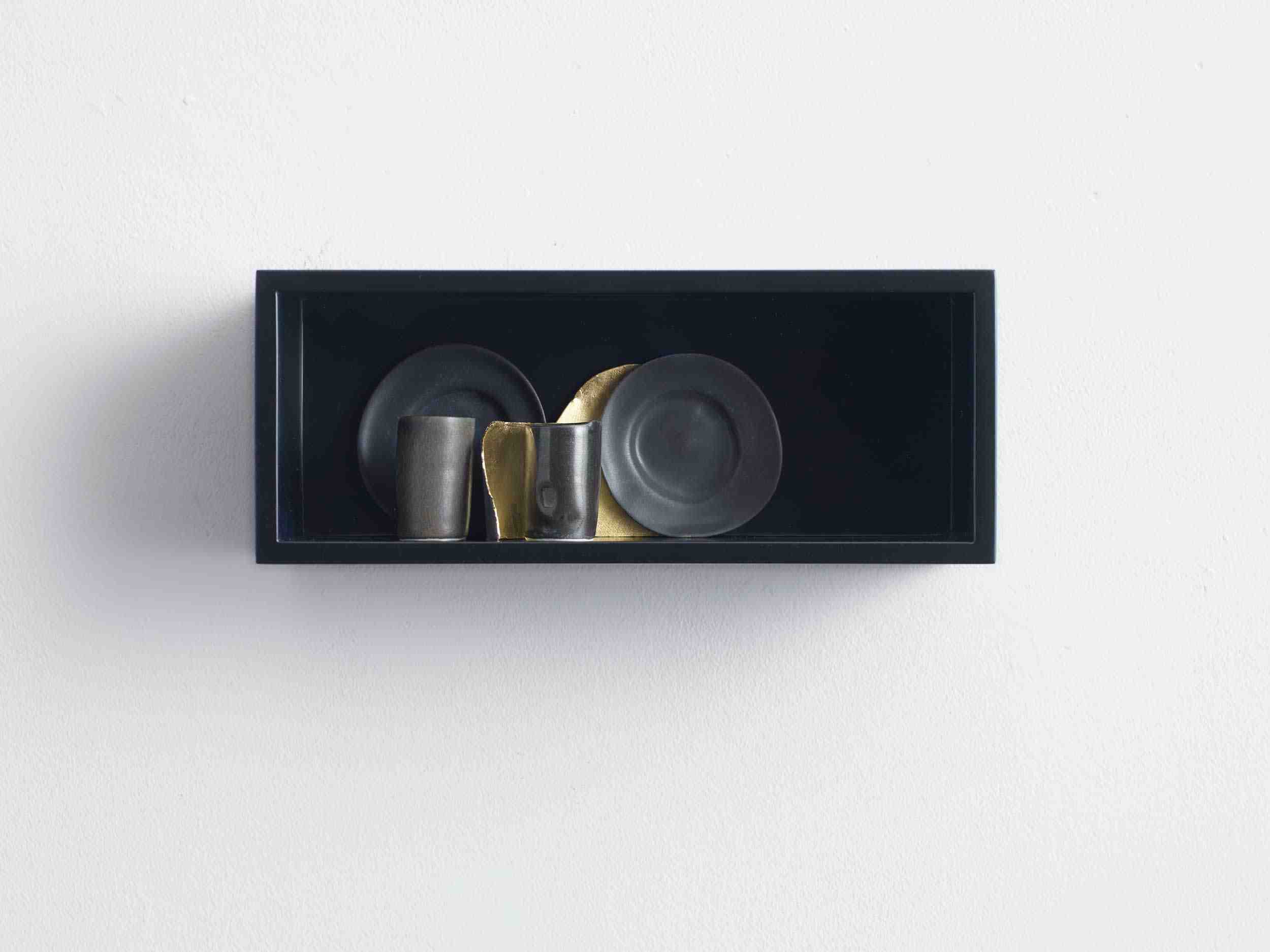
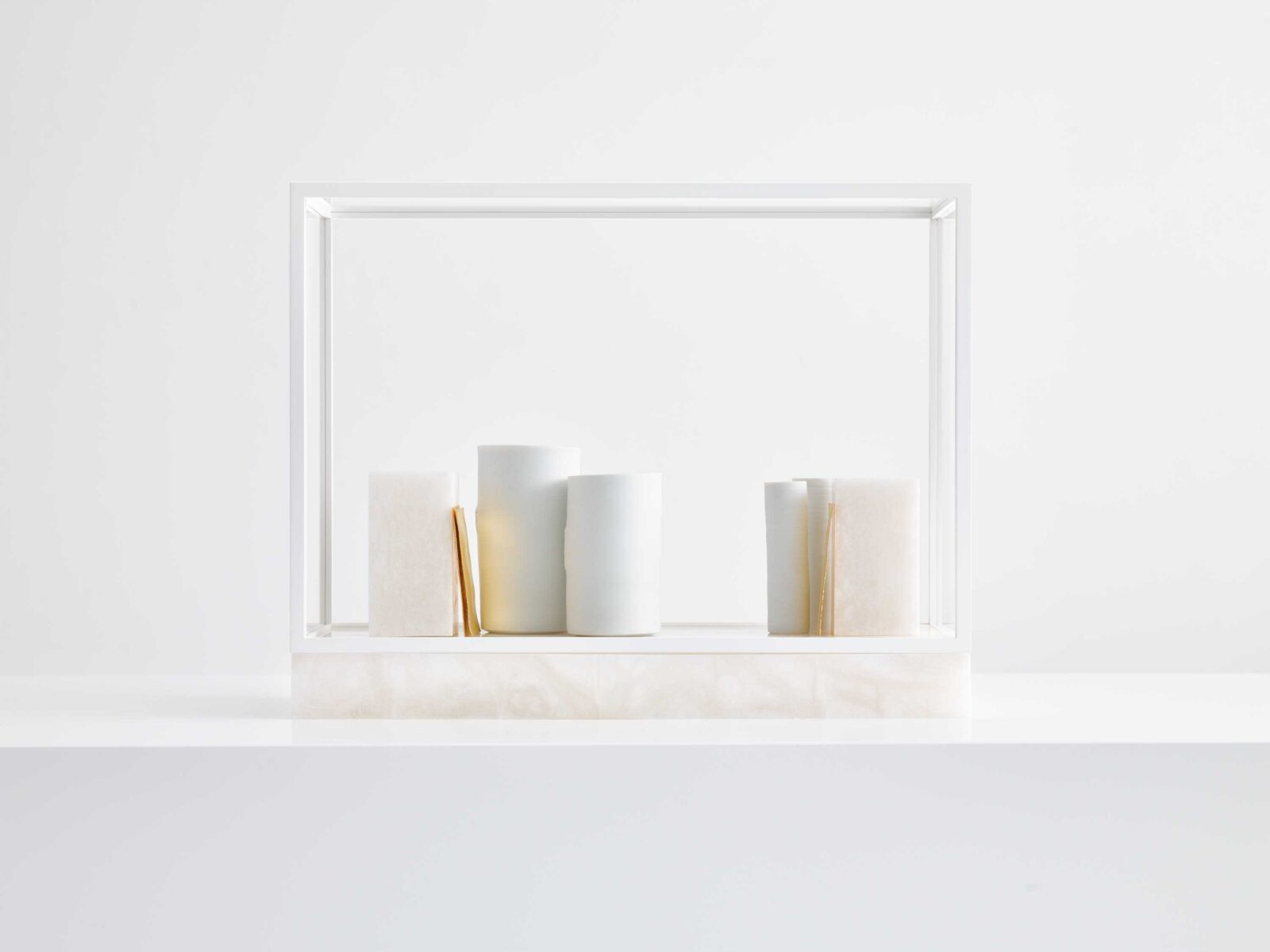
This poetry has been alongside me for my whole adult life, both solace and challenge. For this last year it has been close by, read and re-read. And responded to: here are ten Elegies that I have made in the last months, placings of porcelain vessels amongst slivers of translucent alabaster, thin wafers of gilded porcelain, pieces of heavy steel. These things are held and paused, away from the endless traffic of the world, in vitrines. And here are two installations I have made called Bruchstücke, recalling the Rilke’s descriptions of fragments in Sonnets to Orpheus.
These works aren’t direct transcriptions of mood – but they are elegies in the way that I think Rilke explores elegy. Elegy is a way of marking absence.
It is a central act, the recognition of loss as the precondition of making art happen. That is why Orpheus threads through his poetry, the unendliche Spur, the unending trace of Orpheus.
Elegy is a naming. And it is exacting:

‘…perhaps we are here in order to say: house,
bridge, fountain, gate, pitcher, fruit-tree, window –
at most: column, tower… But to say them, you must understand,
oh to say them more intensely than the Things themselves
ever dreamed of existing…
Here is the time for the sayable, here is its homeland.
Speak and bear witness…’
‘…Sind wir vielleicht hier, um zu sagen: Haus,
Brücke, Brunnen, Tor, Krug, Obstbaum, Fenster, -
höchstens: Saüle, Turm… aber zu sagen, verstehs,
oh zu sagen so, wie selber die Dinge niemals
innig meinten zu sein’…
Hier ist Säglichen Zeit, hier seine Heimat.
Sprich und bekenn. [1]
Elegy isn’t nostalgia or melancholic, it has a proper weight. Bearing witness is a carrying and a placing, a putting-down.
And Rilke’s poetry is full of hands, grasping, holding, letting go. I remember his description of a potter at work in Egypt, his absorption in making. Making is a sort of migration of the self into something else and it has always struck me that Rilke’s transition into roses, statues, panthers, grave goods makes complete sense for me as a maker of things.
His early poems are Dinggedichte, thing-poems. ‘The thing is definite, the art-thing must be still more definite, removed from all accident, reft away from obscurity...’, Rilke writes. His poems are full of epiphanies, moments when things come alive – a dancer’s first movement is the flare of a sulphur match. Or of moments when there is a change in the summer weather, a catch in mood when you see someone as if for the first time.
And his poems are full of danger, ‘all art is the result of one’s having been in danger, of having gone through an experience all the way to the end, where no one can go any further.’ This is what it is like to be an artist, he says, breath-catchingly. You are unsteady on the edge of life, like a swan, before an ‘anxious launching of himself / On the floods where he is gently caught’.
ii
When my grandmother Elisabeth was eighty and I was fourteen or so I started sending her my schoolboy poetry and I would get in return careful critiques and suggestions of what to read. She sent me Rilke. I read poetry all the time. I had a passionate silent longing for the girl in the bookshop where on Saturday afternoons I would spend my pocket money on slim volumes of Faber poets. I carried poetry in my pocket at all times.
Elisabeth’s criticism was direct. She hated sentimentality, ‘emotional inexactitude’. She thought that there was no point in having formal poetic structures if they didn’t scan. No points for my sonnet sequence on the dark-haired girl in the bookshop then. But her greatest scorn was for the indefinite, a blurring of the real in rushes of emotion.
It was not until after Elisabeth died aged ninety-three that I realised how important Rilke was to her. I knew that there were some letters but they were a rumour, a muffled roll of splendour. It was when I stood in front of the statue of Apollo with his lyre in the courtyard of the Palais Ephrussi in Vienna on a winter’s afternoon and haltingly tried to remember Rilke’s poem about the panther, the marble glistening like ‘a predators coat’, that I knew I had to find them.
Elisabeth had been given an introduction to Rilke by her uncle, Pips, Philip Schey von Koromla. Pips had helped Rilke when he was stranded by the outbreak of war in Germany. Now he wrote to invite Rilke to their country house Kövecses – ‘this house is always open for you. You would make us all very happy if you would announce yourself “sans ceremonie”.’ And he begged permission for his favourite niece to send some poems. Elisabeth wrote – breathlessly – to Rilke in the summer of 1921 enclosing Michelangelo, a verse-drama, and asking him whether she might dedicate it to him. There was a long delay until the spring – a delay occasioned by his finishing the Duino Elegies – but then he wrote back a five-page letter and they began to correspond, the twenty-year old student in Vienna and the fifty-year old poet in Switzerland.
The correspondence started with a refusal. He resisted a dedication. The best outcome would be to have the poem published, then the book ‘would represent a lasting link to me… It will be a pleasure to accept being a mentor in your ‘Erstling’(first work), but only if you don’t name me.’ But, continues the letter, I would be interested to see what you are writing. They wrote to each other for five years. Twelve very long letters from Rilke, sixty pages interspersed with fragments of manuscript copies of his recent poems and translations, and many volumes of his verse with warm dedications of his own.
If you stand in a library and look at Rilke’s collected works, the yard or so of volumes, most of them are letters, and most of these seem to be to ‘titled, disappointed ladies’ to borrow John Berryman’s penetrating phrase. Elisabeth was a young poetic Baroness and so not unusual amongst many of his correspondents. But Rilke was a great letter writer, and these are wonderful letters, exhortatory, lyrical, funny, and engaged, a testament to what he called ‘a writing friendship’.
Translating the work of his friend the French poet Paul Valery, Rilke writes about his ‘great silence’, the years when Valery didn’t write poetry at all. Rilke encloses the translation he has just finished. He writes about Paris and how the recent death of Proust has affected him, has made him think of his years there, working as Rodin’s secretary, makes him wish to return and study again. Has she read Proust? She should do so.
And he is very careful and particular about Elisabeth’s situation in Vienna. He is intrigued by the contrast between her academic studies at the university where she is studying law and her poetry: ‘Be that as it may, dear friend, I am not anxious for your artistic abilities, to which I attach such a great importance... Even though I cannot foresee which path you will decide to take with your law doctorate, I find the great contrast between your two occupations positive; the more diverse the life of the mind, the better the chances are that your inspiration will be protected, the inspiration which cannot be predicted, that which is motivated from within.’
Rilke reads her recent poems A January Evening, Roman Night and King Oedipus: ‘All three good, however I tend to put Oedipus over the rest’. In this poem she writes about the King leaving the city into his exile, his hands over his eyes, wrapped in a cloak, and that ‘the others went back to the Palace, and all the lights were extinguished one by one’. She has spent enough time with her father Viktor and his Aeneid for exile to provoke powerful emotion in her.
If Elisabeth has time at the end of her studies she could read literature but Rilke’s advice is ‘to look into the blue of the hyacinths. And the spring!’ He gives her specific advice about her poems and about translation, after all ‘it is not the gardener who is encouraging and caring who helps, but the one with the pruning-shears and spade; the rebuke!’ He shares his emotions about what it is like to have finished a great work. You feel a dangerous buoyancy, writes Rilke, as if you could float away.
Through these letters Rilke becomes lyrical. ‘I believe that in Vienna, when the dragging wind is not cutting through you, you can sense the spring. Cities often feel things in anticipation, a paleness in the light, an unexpected softness in the shadows, a gleam in the windows – a slight feeling of embarrassment of being a city… in my own experience only Paris and (in a naïve way) Moscow absorb the whole nature of the spring into them as if they were a landscape.’
And then he signs off: ‘Farewell to you for now: I deeply appreciated the warmth and friendship of your letter. May you keep well! Your true friend RM Rilke.’
Just think what it must have been like to get that letter from Rilke. Imagine seeing his slightly right sloping and looping handwriting on the envelope as the post is brought into the breakfast room in the Palais, your father at one end opening the beige book-catalogues from Berlin, your mother at the other with the feuilleton, your brother and sister arguing quietly. Imagine slitting the envelope open and finding that Rilke has sent you one of his Sonnets to Orpheus and a transcription of a poem of Valery. ‘It is like a fairytale. I cannot believe it belongs to me’, she writes back that night from her desk pushed up against the window onto the Ring.
They planned to meet. ‘Let it not be a short hour, but a real moment of time’, he writes, but they were unable to meet each other in Vienna and then Elisabeth got the time wrong for their meeting in Paris and had to leave before he arrived. I find their telegrams. Rilke at the Hotel Lorius in Montreux 11H 15 to Mademoiselle Elisabeth Ephrussi, 3 Rue Rabelais Paris (Reponse Payee) and her response forty minutes later and his the next morning.
Then he was ill and couldn’t travel and there is a hiatus while he is in the sanatorium where they are trying to treat his tuberculosis, then a final letter a fortnight before his death. And later a package from Rilke’s widow in Switzerland returning her letters to him, reuniting their fragments of correspondence into one manila envelope carefully marked and carefully put away in one drawer and then another over Elisabeth’s long life.
In 1922 in Vienna in the Palais Ephrussi there are three rooms in a row. On one side is Elisabeth’s room, now a sort of library, where she sits and writes poetry and essays and letters. On the other is Viktor’s library. In the centre is her mother Emmy’s dressing-room with its great mirror and dressing-table with its posy of flowers from Kövecses and the vitrine of netsuke.
I think of this room and remember Rilke writing of ‘a vibrating stillness like that in a vitrine’.
iii
And I come back to these lines of Rilke:
‘And we, spectators, always, everywhere,
turned towards the world of objects, never outward.
It fills us. We arrange it. It breaks down.
We rearrange it, then break down ourselves.’
Und wir: Zuschauer, immer, überall,
dem allen zugewandt und nie hinaus!
Uns überfüllts. Wir ordnens. Ed zerfällt.
Wir ordnens wieder und zerfallen selbst. [2]